Picture this: you’re sitting on a terrace by Levante Beach, a café con leche in hand, and you look up at the sky. But instead of the sky, you see skyscrapers. Towers of glass and steel rise around you, as if you were in New York, not on the Mediterranean coast. This is Benidorm – a place where you see such a strange mix of past and future that sometimes you don’t even know which continent you’re on.
But what if I told you that just seventy-something years ago, there was only a quiet fishing village nestled among sun-melted rocks? Barely a few thousand people who caught fish, mended nets, and dreamed that maybe one day they’d pass through Alicante, the “big city.”
This is a story about how a place changes forever. And how sometimes one person’s boldness is enough to transform an entire city.
When the Sea Gave Everything
If you went back in time, say to the 1940s, you’d find a completely different Benidorm. The heart of the town was a small peninsula where whitewashed houses clung to the rocks. On narrow streets, women dried fish, children ran barefoot, and everywhere you could hear the sound of the sea.
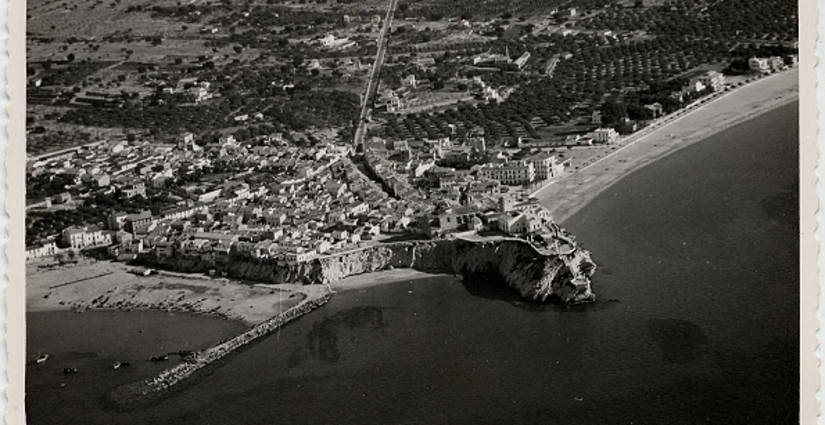
photo by: VisitBenidorm
Fishing here wasn’t a hobby. It was life itself. Benidorm fishermen were famous for their bravery – they didn’t just fish along the coast, but spent months on the Atlantic Ocean, in distant waters where tuna swam. When a boat returned home, the whole village waited at the harbor. The price of fish, the size of the catch, the sea stories – all of this determined the rhythm of life.
And there was something else special here: the almadraba. This was an ancient Arab method of catching tuna. Huge net labyrinths were placed in the sea, and the fish, as they migrated, got caught in this trap. The last almadraba operated in Rincón de Loix bay – right where tourists sunbathe today, not suspecting that this was once the town’s most important industry.
When Everything Changed
In the early fifties, something broke. The civil war had devastated the country, people were poor, and fishing no longer brought in as much income as before. Young people moved away. The paint on houses faded. And slowly everyone began to feel that something new was needed.
That’s when a young man who became mayor stepped onto the scene. His name is Pedro Zaragoza, and although no one knew it then, he’s the one who would change everything. Well, honestly, most people thought he’d gone mad.
Because what did this man say? That Benidorm would become a tourist destination. That foreigners would come from all over Europe to vacation here. That hotels would be built, and the beaches would be teeming with people. The fishermen shook their heads. The bishops were outraged. But Zaragoza didn’t give up.
One day he got on his motorcycle and rode to Madrid. He went to General Franco himself to present his dream. And he told him: “Benidorm can be Europe’s new paradise. But for this, you must allow people to dress modernly, to feel good, to breathe free air.”
In other words? Allow the bikini.
The Bikini Revolution
This sounds funny today, but back then it was a huge deal. In 1950s Spain, women could only go to the beach in completely closed swimsuits. A foreign tourist woman who walked in a bikini received a serious fine. Zaragoza, however, felt that if Benidorm wanted to be a modern tourist town, it had to provide European freedom.
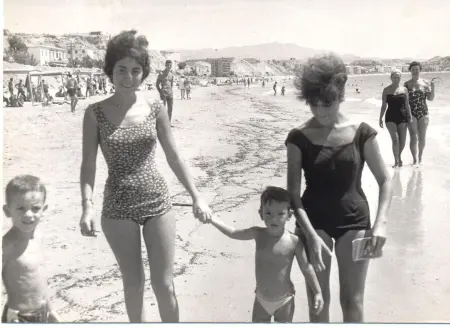
photo by: anotherbagmoretravel
And he did it. He allowed the bikini. The news spread like wildfire, and Benidorm suddenly became a symbol of progress. Tourists started arriving. First Spaniards, then Dutch, Germans, then British. Everyone wanted to go where life was “free.”
The Birth of Skyscrapers
But Zaragoza wasn’t just thinking about bikinis. He saw something else too. While neighboring villages expanded horizontally, with small villas and family houses, he said: “We must build upward.”
And thus was born the vision that makes Benidorm unique today: a city of skyscrapers. But why? Because if you build upward, you leave space on the ground. More parks, more promenades, wider beaches. People can be close to the sea but not crowded together. Everyone can have a balcony, a view, fresh air.
This wasn’t just an architectural decision – it was a life philosophy. And it worked.
The Years of Transformation
The 1960s brought the real change. Alicante airport opened. Charter flights appeared. British retirees, German families, Scandinavian youth – everyone wanted to come to Benidorm. Hotels were built one after another. From a quiet fishing village in the fifties, by the seventies it became one of Europe’s largest tourist centers.
Many locals left net-making and fishing to become hospitality workers, chambermaids, waiters, hotel managers. Children who ran around the harbor now learned foreign languages. The old town houses that were crumbling were renovated – restaurants, craft shops, tapas bars opened in them.
And meanwhile, the towers grew. Taller and taller, more and more modern. The Gran Hotel Bali, almost two hundred meters high. The Intempo, the twin tower that looks like a giant “M” in the sky. And now an even taller one is being prepared – almost two hundred and thirty meters – which would be Europe’s tallest residential building.
The Old Town That Remained
But you know what’s best about Benidorm? That meanwhile, the old town remained.
If you head to the peninsula where the fishermen once lived, you still find whitewashed houses, cobblestone streets, a small church on top of the hill. There’s a square there, the Balcón del Mediterráneo – the Mediterranean Balcony – where you stop, look at the sea, and for a moment you feel as if time has stood still.
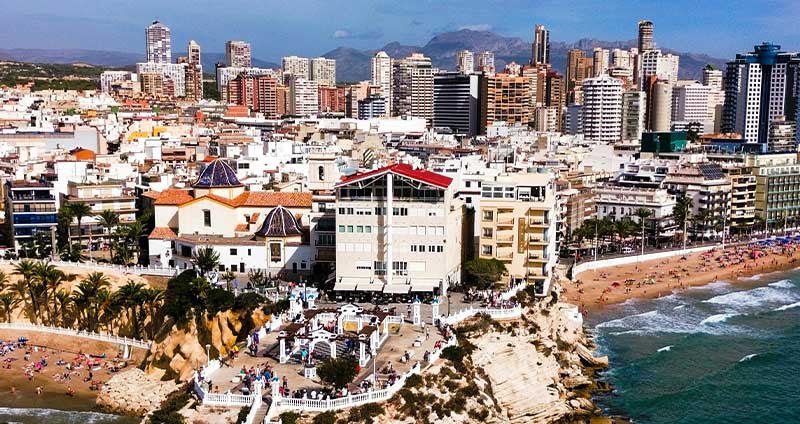
Then you turn around, and there are the skyscrapers. Between the old town and the new city there’s no transition – as if two different worlds were glued together. And somehow it works.
Today: When the City Never Sleeps
Today Benidorm is a place where everything happens twenty-four hours a day. In the morning, retirees walk on Poniente Beach. At noon, families build sandcastles on Levante. In the afternoon, sunbathers lounge by the pools. In the evening, restaurant terraces fill up. At night, bars and clubs open.
There’s everything here: British pubs, German beer halls, Scandinavian wellness centers, Spanish tapas bars. You see the contrast? On one street you smell traditional paella, on another fish and chips are frying. And somehow nobody stands out. Because Benidorm accepts that it’s international.
The beaches? There are three, all Blue Flag certified – meaning they’re clean, safe, well-maintained. Levante is the younger, more energetic side. Poniente is calmer, more family-friendly. And in between is little Mal Pas, squeezed into the old town.
Why Does It Work?
Many people ask: Is Benidorm too much? Too big? Too touristy?
Maybe. But there’s something honest about it. This city doesn’t try to pretend to be an authentic Spanish village. It doesn’t want to be a “hidden gem.” Benidorm is what it is: a modern tourist city that’s proud of what it has achieved.
And what’s most interesting: it works. The skyscraper model is more sustainable than horizontal sprawl. It consumes less land, leaves more green space, makes it easier to get around. People can walk everywhere.
The locals? Many of them have accepted this life. Or gotten used to it. Tourism provides jobs, brings income, and indeed, Benidorm is a wealthy city today.
Worth Visiting?
If you ask me whether it’s worth seeing Benidorm, my answer is: yes, but you need to know what to expect.
Don’t expect to find a quiet, romantic village. Don’t expect local fishermen offering you their fresh catch. Don’t expect to experience authentic Spain.
But if you want to see what happens when a place completely transforms? If you’re interested in how a modern tourist metropolis works? If you enjoy the contrast between skyscrapers and the sea? Then go.
Walk along Levante Avenue, check out the Intempo towers. Go up to the Gran Hotel Bali viewpoint. Then cross to the old town, sit on a small terrace, order a cerveza, and watch the people. And think about how all this must have looked seventy years ago.
Benidorm isn’t perfect. But it’s unique. And that’s worth more than perfection.
The Fisherman’s Son Who Became Mayor
There’s one last thing I need to tell you. Pedro Zaragoza, the man who started all this, was mayor for almost two decades. And when he died, the whole city stopped. Because everyone knew: he’s the one who changed Benidorm.
Some say he made the city a hero. Some say he ruined it. But no one disputes that he transformed it.
And maybe that’s the lesson of this story: sometimes one person’s vision is enough for a place to change forever. Sometimes a bold idea – like allowing bikinis or building skyscrapers – starts something that can no longer be reversed.
Benidorm today is not what it was. But perhaps it was never a place that wanted to stay the same. Perhaps that’s precisely why it became what it is today: the Mediterranean Manhattan. A place that’s always in motion, always changing, and never sleeps.
And you know what’s best? That little peninsula where it all began is still there. Where the fishermen lived. Where the sea always determined everything.
It’s just in the shadow of towers now. And somehow that’s perfectly fine.
__________________________________________________
For more Costa Blanca tips, follow us on Pinterest! 🧡