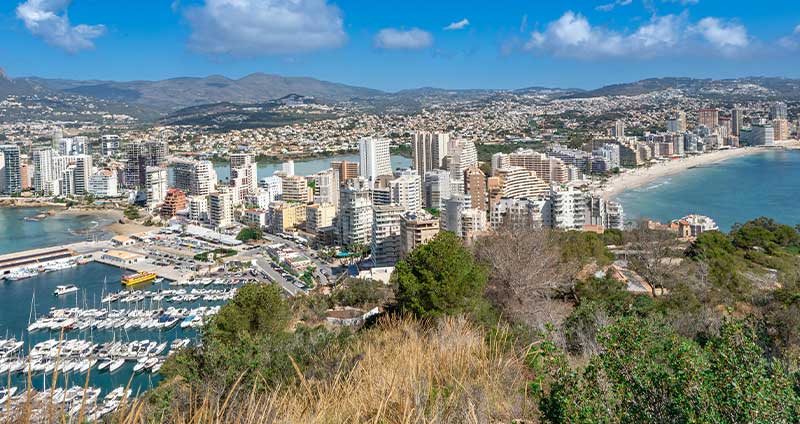
There’s a massive rock on the Costa Blanca that’s so massive that from afar it looks as if an ancient giant left it there before departing the world. The Peñón de Ifach. Three hundred thirty-two meters of limestone rising straight from the sea, which made Calpe what it is today: recognizable, photogenic, iconic.
But if you only see the Peñón, you’re looking in the wrong direction. Because behind the rock, on a small hilltop, hides a labyrinth of white houses. Narrow streets wind up and down. Remnants of walls still stand. A fortified church stands in silence. And if you wander these streets patiently enough, you understand that Calpe wasn’t born today. This place fought for survival for centuries. And the old town – locally called Arrabal – is where that struggle took place.
Come with me, walk this path. Because Calpe’s old town isn’t a tourist attraction. It’s a living, breathing history book that tells what it means to live by the sea when the sea gives not only food but also danger.
The Arrabal – The Labyrinth on the Hilltop
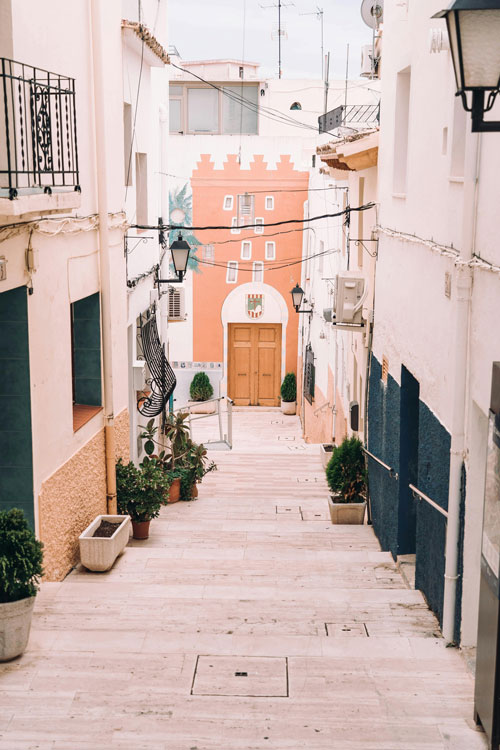
When you first walk into Calpe’s old town, the first feeling is always the same: you stop. Because suddenly all modern noise disappears. The skyscrapers, the shops, the traffic – all vanish. And instead, narrow streets winding upward. Whitewashed houses whose walls bear mosaics, murals, colorful tiles. Stairs that turn unexpectedly. Small squares where a few tables stand and local people play cards.
This is the Arrabal. The high quarter. What was once all of Calpe.
Because remember: when this place was built, they didn’t build on the beach. Not because they wouldn’t have liked to. But because living by the sea was deadly dangerous.
The Pirates Who Didn’t Let Them Sleep Peacefully
Imagine that time. The fifteenth, sixteenth, seventeenth centuries. The Mediterranean wasn’t what it is today: tourists, yachts, vacations. The Mediterranean was a constant battlefield. And the greatest danger didn’t come from armies. But from small, fast boats that arrived at night.
Berber pirates. From North Africa. From Tunis, from Algiers. Who knew that along the Spanish coasts were fishing villages with little defense. Where people slept. Where prey was easy.
And so Calpe – like every coastal settlement – surrounded itself with walls. And not on the beach. But on a hilltop. Where you could see the horizon. Where you could warn if something approached.
And the walls were indeed built. The population lived in a narrow, walled area. And they kept everything inside the walls. Churches, houses, squares. Outside only fields, vineyards, danger.
And there’s one story that touches everyone in Calpe. 1637. The most serious pirate attack in the town’s history.
That night the Berber pirates came so that no one saw them. They got through the single gate – called “El Portalet” – and before anyone could alert anyone, they were inside. In the village. And they plundered, robbed, dragged people away.
The people never forgot that night. And that’s why the walls remained important. Even when the pirates no longer came.
The Torreón de la Peça – Where the Cannon Stood
Today, if you walk in the old town, one of the first things you see is a thick stone tower. The Torreón de la Peça.
But why this name? Why “the piece tower”?
Because the “peça” was there. A cannon. An artillery piece placed there in the fifteenth century, whose job was to defend the town. If they saw pirates approaching, the “peça” sounded. And they hoped it would be enough to frighten them.
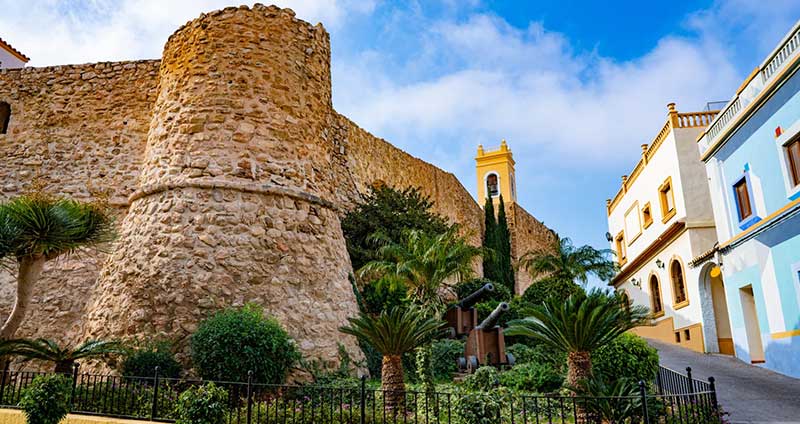
Today there’s no cannon in the tower. But the tower stands. And inside is a curious museum: the Museo del Coleccionismo. A collector’s museum. Old cameras, toys, porcelain, everything people collected over the decades. Strange? Yes. But there’s something charming about it. Because this museum isn’t a big, official institution. It’s a local place where small pieces of the past are preserved.
And if you go up to the top of the tower, you see the entire old town. The white houses. The narrow streets. And of course, the Peñón, which is always there, like a guard watching.
The Iglesia Vieja – The Only One of Its Kind
And then there’s the church. But not just any church. But something that exists nowhere else in the Valencia Community.
The Iglesia Vieja. The Old Church. In Gothic-Mudéjar style. The only one like it in all of Valencia.
Built in the early fifteenth century, on the site of an older chapel. And what makes it special isn’t just its style. But its function.
Because this church wasn’t just a place of worship. It was a fortress.
Yes, you read that right. A fortified church. Because when pirates attacked the town, people ran here. To the church. And hid there. The thick walls provided protection. The door could be locked. And they hoped they’d survive the night.
Today, when you enter, you find yourself in a quiet space. Semi-darkness. Vaulted arches. And a fifteenth-century altarpiece depicting Saint Anthony, Saint Cosmas, and Saint Damian. A tempera painting more than five hundred years old. And which miraculously survived.
But what’s perhaps most interesting isn’t the painting. But the feeling. That when you stand there, you understand that this place isn’t just a monument. This is a place where people prayed for survival.
The Modern Church – Mosaic and Light
And right next to the Old Church stands the new church. Iglesia de Nuestra Señora de las Nieves. Church of Our Lady of the Snows.
This was built in the twentieth century. And it’s completely different. Modern. Bright. And what captures you most is the facade: a giant mosaic. Colorful, vibrant, shining in the sunlight.
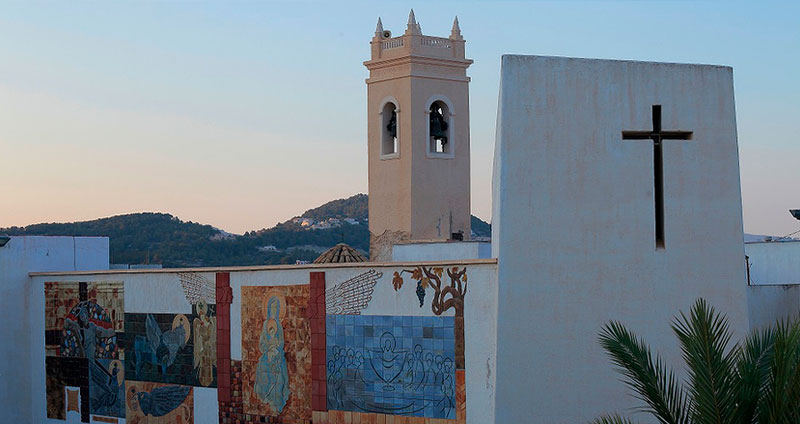
Inside is a large space. Vaulted ceilings with ceramic tiles. Colored windows through which light filters. And this church is no longer a fortress. It’s an open, bright space that shows the past has ended. The wars, the fear, the pirates – all gone.
But the two churches stand side by side. The old and the new. And there’s something particularly beautiful about keeping both. Because it shows that Calpe respects its past but doesn’t get stuck in it.
Plaza de la Vila – Where Everything Meets
And between the two churches is a small square. Plaza de la Vila. The Town Square.
This is the heart. Where people met. Where the priest spoke. Where decisions were made. Where life happened.
This still happens today. Small restaurants around the square. Tables where locals sit and have coffee. And tourists taking photos. But the local people are still there. And that’s what makes this place alive.
Because Plaza de la Vila isn’t a museum. It’s still the town’s heart.
Calle Puchalt – The Staircase That’s a Spanish Flag
And then there’s a small street that’s perhaps the most photographed place in the entire old town. Calle Puchalt.
A narrow street leading upward. But not just a simple street. Because its stairs are painted. Red and yellow. And together they form a huge Spanish flag.
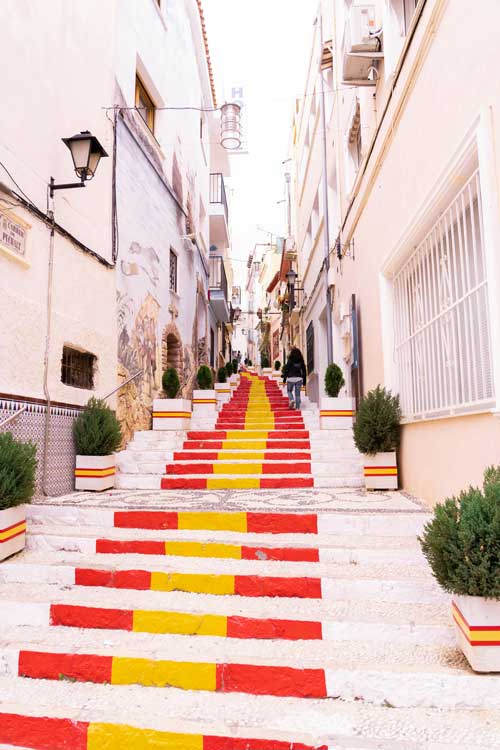
Some say this is “the most Spanish street in the world.” And perhaps they’re right. Because there’s no other place where a flag appears so playfully, so naturally in the middle of a street.
But Calle Puchalt isn’t just good for that. This is where local life shows. Where cats sunbathe on the steps. Where elderly women sit in doorways. Where flower pots hang from every window. And where, if you’re lucky, you might meet a local who’ll tell you what it was like growing up here.
Forat de la Mar – The Window to the Sea
And there’s one more place worth mentioning. The Forat de la Mar. The “Sea Window.”
This is a passageway. A gap in the wall. Which was once a gate and today connects Plaza de los Marineros with a small street. And when you step through it, you feel something change. Because you leave the protection of the old town. And step out into the world.
Long ago this was where fishermen went out. Where they looked toward the sea. Where they checked the weather and whether it was worth going sailing.
Today fishermen no longer stand there. But the place is still there. And if you stand there, you understand why it’s important. Because this is the window. The connection between the protected old town and the dangerous, unpredictable, but nourishing sea.
The Llavador de la Font – Where They Washed Clothes
And if you leave the old town center, a bit farther away, you’ll find a small building. Llavador de la Font. The ancient washhouse.
This is where since 1878 local people brought their clothes to wash. Because there was no running water in houses. No washing machine. There was a spring and a communal washing place. And women went there, washed, talked, shared daily news.

In 1940, when they began piping water to houses, this place slowly became abandoned. Today it no longer operates. But it stands there. And reminds us what life was like when everything was simpler, harder, more communal.
The Past That Hasn’t Passed
When you walk through Calpe’s old town, something strange happens. You don’t feel like you’re in a museum. You feel that this place lives. That people are still here. That history hasn’t ended – it’s just transformed.
The walls that once defended against pirates are now walkways. The church that was once a refuge is now a peaceful place of prayer. The tower from which they once fired cannons is now a museum.
But the essence remained. The old town is still there, on the hilltop. The Peñón still stands like a guard. And the sea is still the same – calm in the morning, stormy in the evening.
And perhaps that’s what makes Calpe special. That here they didn’t have to choose between past and present. Both live together. The modern seaside town with its skyscrapers, beaches, restaurants. And the old town with its narrow streets, white houses, stories.
And when you stand in Plaza de la Vila and look up at the Peñón towering in the sky, for a moment you feel as if you understand. You understand that the past isn’t a burden. The past is a treasure. And Calpe guards this treasure while moving forward into the future.
__________________________________________________
For more Costa Blanca tips, follow us on Pinterest! 🧡