January 6th is perhaps even more important in Spain than Christmas itself. When most countries have long since taken down their Christmas trees and returned to everyday routines, here on the Costa Blanca, a magical holiday atmosphere still fills the streets. This is the day of Día de los Reyes Magos, the Three Kings Day, when Spanish children finally receive their long-awaited gifts, and the entire country experiences a special tradition that has preserved its magic with unwavering enthusiasm for centuries.
The story that lives in every Spanish heart
The story of the Three Kings naturally originates from the Bible, but here in Spain, it’s not just a religious narrative – it’s a living, breathing tradition passed down through generations. Melchior, Gaspar, and Balthazar, the three wise men who followed the star to Bethlehem to bring gold, frankincense, and myrrh to the newborn Jesus.
For Spaniards, these kings are not distant, mythical figures. They are real, warm-hearted characters who return every year to bring joy to children. Melchior is the European king, with his white beard and wisdom; Gaspar is the Asian king, with his youthful vigor; and Balthazar, the African king, who is especially dear to Spanish children’s hearts. Each of the three kings represents a different continent, symbolizing that gifts and goodness are universal, knowing no boundaries.
The magic of celebration
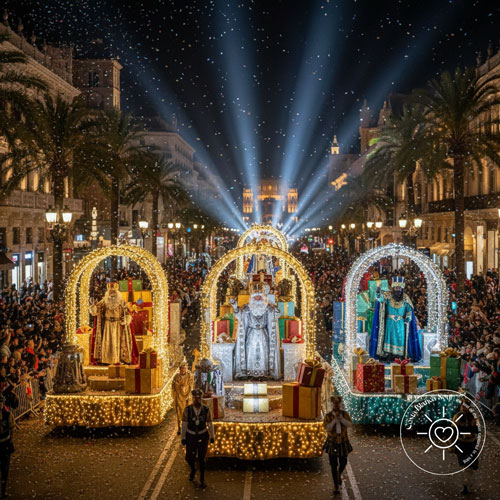
The celebration of Día de los Reyes Magos actually begins on January 5th, early in the afternoon. This is the day when the entire country holds its breath in anticipation. Children excitedly prepare, parents secretly wrap gifts, and everyone focuses on the big event: the Cabalgata de Reyes, the Three Kings Parade.
As dusk falls, the streets of towns and villages come alive. Excitement and magic mingle in the air. Families flood into the streets, children sit on fathers’ shoulders, everyone seeking the best spot to see the approaching magnificent procession. And then… they arrive.
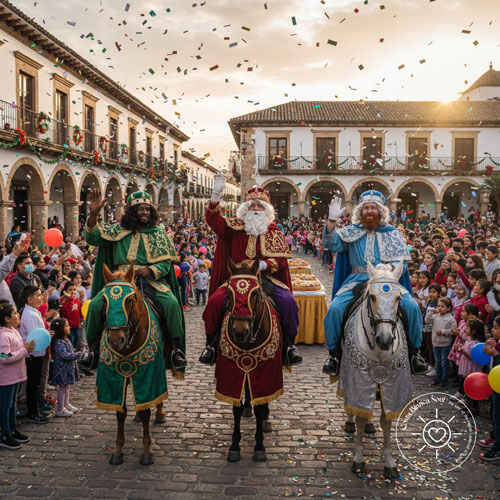
The three kings parade through the streets on massive decorated floats, accompanied by dancers, musicians, clowns, and their helpers. The kings smile and wave, and here’s the best part: they throw candy into the crowd. Not just any candy – caramels and sweets rain down from above, and children (and sometimes adults too) happily catch these heavenly gifts. This isn’t just a parade; it’s a community experience, when the entire city becomes one big family.
Traditions that keep families together
The traditions of the Three Kings celebration are deeply rooted in Spanish culture. Weeks before January 6th, children begin writing letters to the kings. These aren’t letters like those to Santa Claus – these are much more personal. Children tell how well they’ve behaved during the past year, what good things they’ve done, and of course, list what gifts they’d like to receive.
The letters go to a special place: some drop them in the kings’ mailboxes (special mailboxes appear in cities in early January), while others place them on the balcony so the kings’ camels can find them. Yes, you read that right – their camels! Because these kings don’t arrive on sleighs, but traditionally on camelback, since they come from far away, from the East.
On the evening of January 5th, after the parade, comes the most magical ritual. Children prepare shoes at home, which they place in front of the door, under the window, or on the balcony. In many families, children also leave out a glass of water and some hay or carrots for the camels – after all, the long journey is tiring, and the royal camels deserve some care too. In some families, the children themselves also receive a small drink and some sweets, so the kings can rest as well.
And then comes the waiting. Going to bed that evening is especially difficult – who could sleep knowing that three kings will be visiting their home during the night? But eventually, every child falls asleep, dreaming of what gifts they’ll find in the morning.
On the Costa Blanca – where tradition takes on special colors
Here on the Costa Blanca, where you also live, Día de los Reyes Magos is especially magical. The Mediterranean climate allows the parades to take place outside, in the mild winter evening, where starlight merges with decorative lighting.
In Alicante city, the Cabalgata is one of the biggest and most spectacular parades in the entire region. The three kings arrive on massive, decorated floats, and the procession lasts for hours, filled with local dance groups, musicians, and colorful characters. Children arrive with huge bags to collect as much candy as possible.
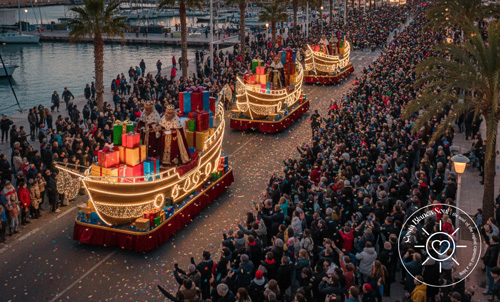
In Torrevieja, Benidorm, Dénia, Jávea, and the smaller coastal villages, every community celebrates this special day in its own way. In some places, the kings arrive by sea, on boats, making the event even more spectacular. Can you imagine? Three kings, in ornate costumes, arriving on the waves of the Mediterranean Sea – this is truly Spanish-style grandeur!
In smaller villages, such as Altea or Guadalest, the celebration is more intimate, more family-oriented. Here everyone knows everyone, and the Cabalgata is more like a large community gathering, where locals celebrate together, and children know by name those who play the kings and their entourage.
A feast of flavors – the Roscón de Reyes
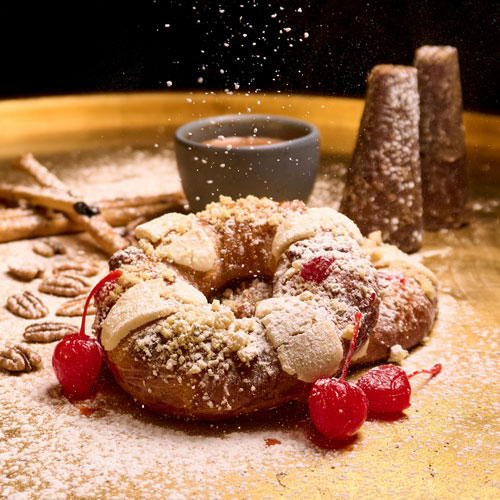
No celebration in Spain is complete without special foods, and Día de los Reyes Magos is no exception. The star of the day is the Roscón de Reyes, a beautiful, wreath-shaped sweet cake that can be found in every pastry shop and bakery during the first days of January.
The history of the Roscón is as rich as the celebration itself. This special pastry is made from yeast dough flavored with orange blossom water, decorated with candied fruits – orange peel, lemon peel, and cherries – reminiscent of the kings’ crowns. But the true magic of the Roscón lies not in its exterior, but in what’s hidden inside.
Two surprises are baked into the cake: a small figurine (traditionally depicting baby Jesus, but nowadays many forms appear) and a bean. The lucky person who finds the figurine in their slice becomes the king or queen of the day and receives a crown. But beware! Whoever finds the bean has to pay for the Roscón – or at least that’s the tradition, although nowadays it’s more of a good joke than an actual rule.
The Roscón is usually consumed on the morning of January 6th, right after children have discovered their gifts. The family gathers in the kitchen or living room, sipping hot chocolate or coffee, and shares the cake together. This moment is just as important as the gifts themselves – the time together, the laughter when someone finds the figurine or bean, the children’s happiness, and the sense of family unity.
On the Costa Blanca, many local pastry shops make artisan Roscones, which are true masterpieces. Some are traditional, others offer modern variations – filled versions with cream, chocolate, or truffle cream. In many families, it’s a tradition to order the Roscón from a specific pastry shop year after year, and this too is part of the celebration’s ritual.
Other flavors and traditional dishes
While the Roscón de Reyes is undoubtedly the star of the day, other delicacies also find their place on the festive table. January 6th is generally the closing of the long holiday season, so many families still consume Christmas-time foods – turrón, polvorón, and mantecado.
In some regions, though this is less common on the Costa Blanca, fish or seafood dishes are served on this day, recalling that the kings made a long journey across seas. In the Valencia region, it sometimes happens that paella is prepared, which always counts as a festive dish.
But perhaps the most important “food” on this day is still hot chocolate. In Spain, hot chocolate is thick, rich, and intense – not a watery cocoa, but a real chocolate experience, often consumed with churros. On the morning of January 6th, many families go to the local churrería for churros and consume this heavenly combination at home or on the spot, while talking about the gifts.
Gifts and expected surprises
While in many countries gifts wait under the Christmas tree on December 25th, in Spain children patiently wait until January 6th. And it’s worth the wait! The kings’ gifts are special – these aren’t just toys, but signs of love and care.
According to tradition, children who have behaved well receive beautiful gifts. But those who haven’t been good enough… well, they might find lumps of coal in their shoes. Of course, nowadays this “coal” is actually black candy made from sugar, so in the end no one is left empty-handed – though the warning message is clear!
Interestingly, many Spanish families now give gifts twice: smaller gifts at Christmas (often attributed to Santa Claus or Baby Jesus) and the main gifts from the Three Kings. This practice has spread especially with growing international influences, but for most Spanish families, January 6th remains the real gift-giving day.
The magic that lives on
As the day progresses, families gather for larger family lunches. This day is about reconciliation, about being together. Grandparents tell stories from their own childhood, about how they celebrated the Three Kings, and children enthusiastically show off their new toys.
On the streets, you can still feel the magic of the celebration. The decorations are still up, smiles on people’s faces, and there’s something in the air – the sense of community, the continuity of tradition, the knowledge that we’re experiencing something truly special.
Living on the Costa Blanca, we’re especially fortunate to be part of this beautiful tradition. We can see how local communities relive this magical celebration year after year, preserving their traditions while embracing those who have found a new home here, in this wonderful Mediterranean region.
Why is this celebration so special?
Día de los Reyes Magos is more than just a day in the year. It’s a cultural identity, a family tradition, a childhood memory that permeates everything. This is the celebration that shows how important family, community, and traditions are to Spaniards.
When you walk through the streets of the Costa Blanca on January 6th and see the happy families, the children with sparkling eyes, the sense of togetherness, you understand why this day is so special. It’s not just about gifts – although they’re important too – but about the magic that only holidays can create, when every generation experiences something together that is timelessly beautiful.
And perhaps this is the most beautiful message of the Three Kings celebration: the magic never fades if we preserve and pass it on to the next generations. Just as Melchior, Gaspar, and Balthazar return year after year, so this wonderful tradition lives on, enriching our lives here on the sunny Costa Blanca.
¡Feliz Día de Reyes! Happy Three Kings Day! 🌟
__________________________________________________
For more Costa Blanca tips, follow us on Pinterest! 🧡