There’s a city in Spain where more palm trees live than people. Where the past and present coexist in such natural harmony that when you walk through the train station doors, you immediately feel as if you’ve stepped into North Africa. This is Elche – Europe’s only true palm city. And if you thought this was just a pretty park, you’d be wrong. Because what you see here is a living history book, an Arab dream conceived a thousand years ago that still breathes, lives, and keeps renewing itself.
Come with me, let me show you something. Let me show you a place where the past isn’t a museum but everyday life. Where date cultivation isn’t just a profession but an art. And where white palm leaves travel to all corners of the world – from the Vatican to the Spanish royal family.
The City of Palms
When I first arrived in Elche, I didn’t know what to expect. An industrial city, they said. The center of shoe manufacturing. But when I stepped out of the train station, I stopped. Because palm trees were everywhere around me. Not just one or two decorative trees, but forests of them. Palm trees as far as the eye could see. And as I went deeper into the city, I realized something: this isn’t a city that has palm trees. This is a palm forest that has a city.
More than two hundred thousand palm trees. Think about that number for a moment. Two hundred thousand. About two hundred and forty thousand people live in Elche, which means there are almost as many palm trees as residents. And these aren’t just randomly planted trees. They’re all part of a thousand-year-old plan.

When the Arabs Planted a Dream
If you went back in time about a thousand and fifty years, you’d see a completely different landscape. Dry land, a small river – the Vinalopó – that sometimes dried up completely, and a few scattered settlements. But then, in the late tenth century, the Arabs arrived and said: “We’ll build an oasis here.” And they didn’t just talk about it. They did it.
The Palmeral – as the Elche palm grove is called – isn’t a natural forest. It’s a carefully designed agricultural system that the Arabs brought with them from North Africa. They didn’t just plant palm trees – they built a complex irrigation system, canals that took water from the Vinalopó exactly where it was needed. Each plot – called huerto – was shaped into a square, and palm trees were planted along the edges.
But why? Why on the edges? Because the palms provided shade. The Arab farmers knew that nothing else would grow in this scorching sun. But if you plant palms along the edges of the plot, they protect the inner area where you can grow vegetables, wheat, and fruits. And of course, the palms themselves produce: dates. This was the European adaptation of desert life. And it worked.
Dates – The Bread of the Desert
I don’t know about you, but until I went to Elche, I never thought much about dates. That sweet brown thing we eat at Christmas, right? But dates are so much more than that.
For the Arabs, dates weren’t dessert. They were the basis of survival. A healthy date palm can produce a hundred to two hundred kilograms of fruit per year. And dates don’t spoil – they can be stored for months, full nutritional value, full energy. In the desert, where water is scarce and soil is poor, the date palm meant life.
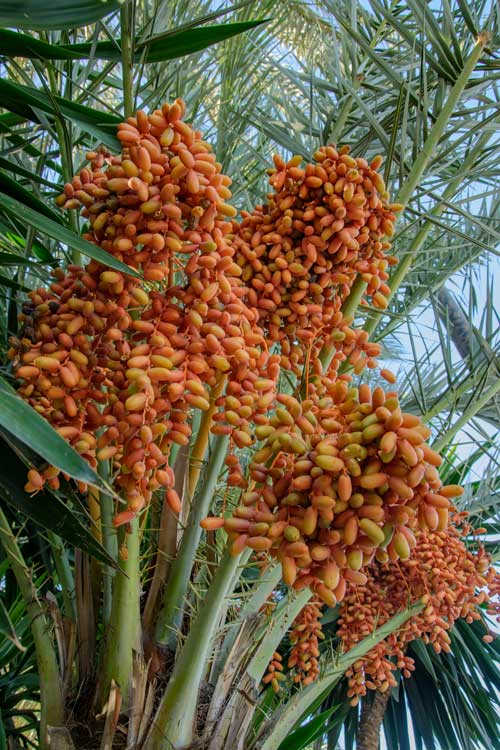
But in Elche, date cultivation wasn’t just about the fruit. Palm leaves were also used. For basket weaving, roofing, fencing. The trunk was used instead of wood. Every part of the palm was valuable. Nothing went to waste.
The Secret of White Palms
And then there’s something special. Something that made Elche world-famous and that’s unique in the world. The white palms.
If you walk around Elche, especially in the outskirts, you’ll notice something strange: many palm trees have black plastic on them. As if they were wrapped in packaging material. And indeed, they are. But not to protect them. But to turn them white.
In June, when young palm leaves begin to grow, gardeners wrap the top of the tree with black film. Sunlight doesn’t reach the leaves, so they can’t produce chlorophyll. And what does a leaf do without chlorophyll? It stays white.
But why? Why would they want white palm leaves? Because of Palm Sunday.
Palm Sunday and the Pope’s Palm
In Christian tradition, Palm Sunday is the day when Jesus entered Jerusalem, and people waved palm leaves at him. In the Catholic Church, on this day, palm leaves are blessed and distributed among the faithful.
And Elche became Europe’s palm supplier.
For centuries, since the fourteenth century, Elche masters have been making palm leaves for Palm Sunday. But not just plain ones. These are works of art. White leaves are woven together, creating intricate patterns: crosses, stars, chains, flowers, and even the shapes of saints.
Every year, the city’s mayor personally sends palm leaves to the Pope. Yes, you read that right: in the Vatican, in St. Peter’s Square, the Pope’s altar is decorated with a white palm from Elche every Palm Sunday. The Spanish royal family receives them too. And the head of government. And of course, they’re sent by the thousands throughout the country and even Europe.
The Serrano Valero Family: Tradition Woven Through Generations
One family name particularly stands out in this story: the Serrano Valero family. They’re the ones who have been doing this for generations. Not just them, of course, but their workshop is one of the most famous.
Mother to daughter, grandmother to granddaughter passed on the knowledge. How to weave white leaves so they form a star. How to join the thin strands to form a chain. And how to work so that not a single leaf breaks – because white palm leaves are extremely fragile.
One family can make up to six thousand woven palms per year. And they also send thousands of plain, straight white palms. This is colossal work. And patience. Endless patience.
The Imperial Palm – The Seven-Armed Wonder
But if you’re in Elche, there’s one place you can’t miss: the Huerto del Cura, the Priest’s Garden. This is a botanical garden that’s one of the most beautiful huertos in the city. You can walk among palms, by lakes, near fountains.
And there’s the star: the Imperial Palm, the Imperial Palm.

This is an almost two-hundred-year-old date palm, and something incredible happened to it. It has seven trunks. Seven separate branches grow from one root, like a giant bouquet. This is rare. Very rare. And so beautiful that when Empress Elisabeth of Austria, called Sisi, visited Elche, she was so impressed that the palm was named after her.
The Imperial Palm is Elche’s symbol today. And when you stand under it, looking up at those seven branches that arch over you like a natural dome, you understand why. Because there’s something magical about it.
When Past and Present Meet
But don’t think Elche only lives from the past. The city is modern, dynamic. It’s the center of the Spanish shoe industry – yes, most Spanish shoes are made in and around Elche. There are factories here, modern buildings, shopping centers.
And yet, the palms are everywhere. In the Municipal Park, where people run, rest, children play. In the old town, where white houses stand among cobblestone streets, and a baroque basilica tower rises toward the sky. In parks, at roundabouts, in residential neighborhoods.
The palms weave through the city. They don’t decorate it – they weave through it. They’re part of everyday life.
UNESCO and the Struggle for Preservation
At the turn of the millennium, UNESCO recognized that the Palmeral is unique. There’s nothing like it anywhere else in Europe. In fact, it’s one of the largest and northernmost palm forests in the world. And so the Palmeral de Elche became a World Heritage Site.
This isn’t just an award. It’s also a responsibility.
Because the palms are in danger. There’s a parasite called the red palm weevil, and this little beetle can destroy a healthy palm in a few months. In recent decades, more than twenty thousand palms have been destroyed in Elche because of it.
The city is fighting back. With chemicals, biological methods, constant monitoring. But this is a battle that never ends. Because the palms aren’t just trees. They’re living history. Every palm you lose is a piece of the past that disappears forever.
Date Harvest – Just a Memory Now?
And the dates? That sweet fruit for which they started all this?
Today, dates are hardly harvested in Elche anymore. The groves have lost their agricultural function. People don’t make a living selling dates. In a few huertos, there’s still a harvest, and they can be sold at the local market. But this is more tradition than business.
The real value today isn’t in the dates. It’s in the palm forest itself. The landscape. The history. The culture.
And of course, in the white palms that set out into the world again and again before every spring.
A Walk in the Palmeral
If you go to Elche – and I suggest you do – there’s a five-kilometer hiking trail, the Ruta del Palmeral. It passes through the most important huertos, shows you what an Arab agricultural plot looked like a thousand years ago, and takes you to the Palmeral Museum, where you can learn the whole story.

photo by: Ayutamiento de Elche
You walk on narrow paths where palms bend over you. You cross bridges under which old irrigation canals flow. You stop at the gate of a huerto and look in. You see the square plot, the row of palms, and you imagine that there was once a grain field here, where Arab farmers worked in the heat of the day.
And for a moment you understand. You understand why this is special.
Why Should You Go to Elche?
I know what’s going through your head. “Okay, nice palm trees. But is it worth traveling for?”
And I tell you: yes.
Elche isn’t a typical tourist destination. There are no skyscrapers waiting for you like in Benidorm. There’s no beach here. There won’t be crowds, there won’t be rows of tourist buses.
But there’s something else here.
There’s a feeling that you’ve stepped through time. That you’re in a place where the past still exists. Not as a museum. But as a living reality.
And if you have a little appreciation for history, traditions, and craftsmanship, Elche will fascinate you. Because here every palm leaf is a story. Every huerto is a memory. And every white palm that someone holds on Palm Sunday is a piece of Elche that lives on.
The Arab Dream That Lives On
When the Arabs built the Elche Palmeral a thousand years ago, they didn’t just create an agricultural system. They brought a way of life with them. Knowledge of how to live in the desert. How to make fertile what is barren. How to create an oasis where no one would believe it’s possible.
And this dream outlived them.
It survived the Christian reconquest. It survived the centuries. It survived modernization. And it’s still here today.
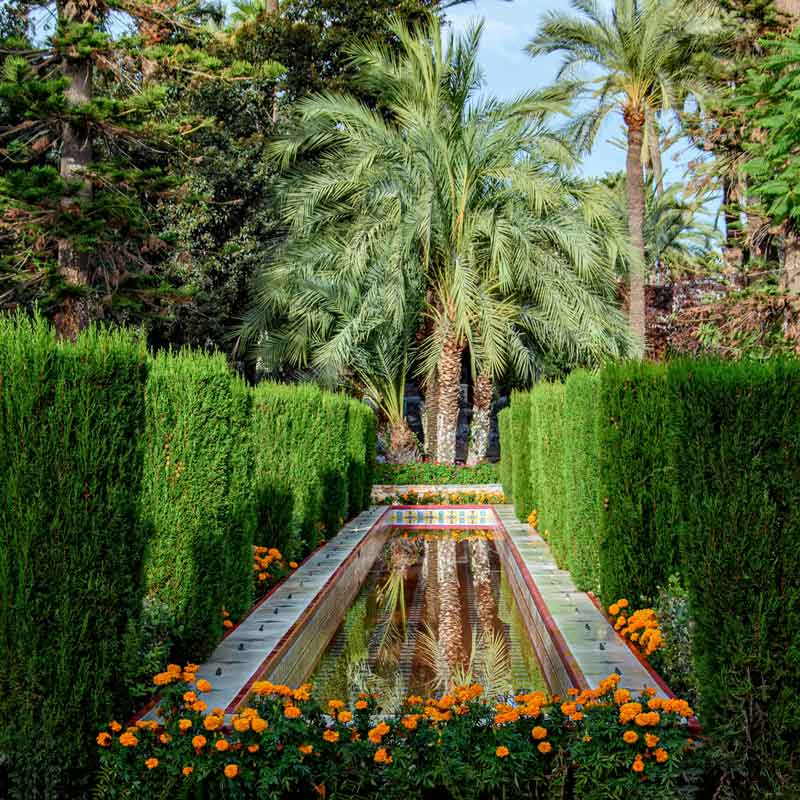
When you stand in the Palmeral, looking up through the palm fronds where sunlight filters through, and you hear the wind rustling through the leaves, you understand that this is more than a park. This is a living connection to the past.
And perhaps that’s what most of us long for today. Something that survives. Something that remains. Something that reminds us that there were people who planted a dream, and that dream came true.
Elche is that dream. The palm trees are the proof. And the white palm leaves, which are reborn before every spring, are the message: the past lives, and the future is in our hands.
__________________________________________________
For more Costa Blanca tips, follow us on Pinterest! 🧡