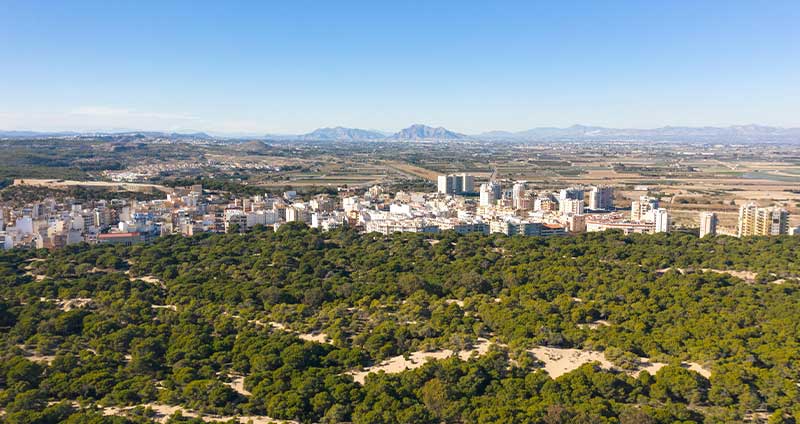
There’s a forest on the Costa Blanca that shouldn’t exist. A forest that isn’t natural. A forest that’s there because once, long ago, a man said: “I must stop the sand.” For thirty years, every single day, he did just that.
Today, when you walk along the shore of Guardamar del Segura, you see the trees. Pines, palms, eucalyptus stretch eleven kilometers along the sea. Perhaps you think this was always here—a natural Mediterranean forest.
But if you knew the truth, you’d stop. This forest isn’t here to be beautiful. This forest is here to save the town from destruction. Behind it lies a story that shows what perseverance means. What it means to believe in something when everyone says otherwise. What it means to dedicate a single life to a dream.
When the Sea Betrayed the Land
To understand what happened to Guardamar del Segura, we have to go back to the eighteenth century—a time when Spain was building a fleet. A huge fleet. Warships that ruled the seas.
They needed wood for this. Lots of wood. Strong, durable wood.
Where was the wood? In the valley of the Segura River. In a rich, lush forest that had stood there for thousands of years. One day, people came with royal orders: “We can cut all this down. The king needs ships.”
So they did. They cut down the forest. All of it. Nothing was planted back. When the last tree was gone, something changed.
The protected ground was now bare. Rain washed away the surface. The Segura River brought sediment with it, washing it out to sea. The sea brought it back to shore. The wind—the Levante, which has always blown here—picked up the grains of sand, setting them in motion.
Slowly, gradually, sand dunes began to form.
At first they were small. Then bigger. Then huge. Then they started to move—two to eight meters inland every year. Slowly, steadily, unstoppably.
1896 – When the Town Was Under the Sand
Imagine that moment. The late 1890s. Guardamar del Segura is a small fishing town with three thousand inhabitants—simple people who work in the huerta, fish, living on the same land for generations.
One day they notice the sand dunes getting closer. No longer on the shore, but in the fields. Then at the garden edges. Then next to the first houses.
Panic breaks out. Everyone sees what’s happening: the sand is swallowing their world.
History shows this had happened before. Centuries earlier, a Phoenician city stood here—La Fonteta, a wealthy trading town. One day the sand swallowed it completely. It disappeared into the fog of history.
Centuries later, an Islamic community built a rabita here—a religious center. The sand swallowed that too.
Now it was Guardamar’s turn.
Francisco Mira i Botella – The engineer who believed
That’s when a man stepped forward. Francisco Mira i Botella, forest engineer from Alicante, heard Guardamar’s desperate call: “I can stop it.”
People looked. They didn’t believe him. How can you stop sand? Sand flows like water. There’s no wall that can hold it. No force that can defeat it.
But Mira didn’t just talk. He knew something—a method, a French technique called Bremontier, already used in France to stop dunes.

Mira said: “We won’t stop the sand with walls. But with life.”
On December 2, 1897, the Proyecto de Defensa y Repoblación de las Dunas de Guardamar del Segura was approved by Royal Decree—the Project for Defense and Reforestation of the Guardamar Dunes.
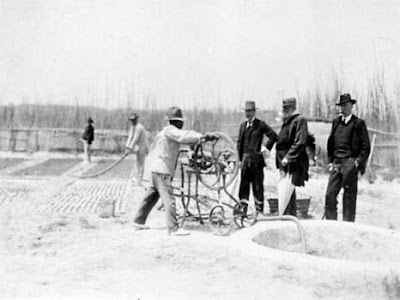
photo by: alicantevivo
In the summer of 1900, Mira arrived. The work began.
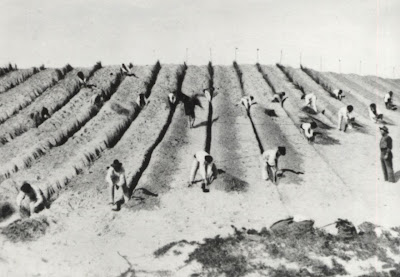
photo by: alicantevivo
The miracle they built by hand
The method Mira used was simple but brutal. It took thirty years. First, on the shore where the sand came out of the sea, he drove stakes—wooden poles in rows—which slowed the wind.
Then he planted marram grass, pitcher plants, palms. Their roots held the sand.
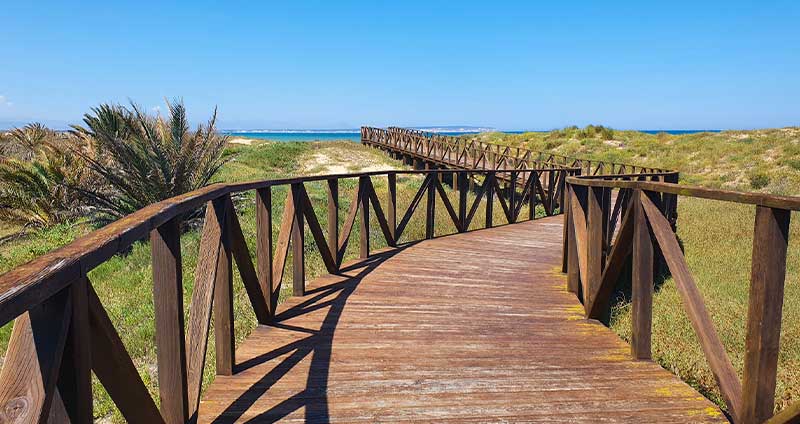
When these strengthened, he began building the “contradunas”—artificial dunes four meters high, which stopped the moving sand.
When the contraduna was ready came the most important part: the forest.
They planted six hundred thousand pines, mainly pinus halepensis. Forty thousand palms. Five thousand eucalyptus.
To protect the young trees from sun, wind, thirst, Mira invented something. He covered each tree with pine branches—by hand. They made bundles called “haces,” placing them over the young plants. This gave shade, kept moisture, provided protection.
They used two hundred fifty-six thousand bundles. Two hundred fifty-six thousand bundles of branches.
Meanwhile they built infrastructure: eight kilometers of roads, fourteen kilometers of contradunas, three nurseries, three forest houses, warehouses.
Every day, every year, Mira was there. He supervised, worked, experimented, believed.
When the King visited
In 1923 something special happened. Alfonso XIII, King of Spain, visited Guardamar to see the miracle. When he arrived, what he saw was astonishing. Where once there were moving sand dunes, now stood a forest—young but living, green, growing.
The king congratulated Mira. The whole country heard the news: the man who stopped the sand. In 1929, when the last tree was planted, Mira wrote in his own words what he had achieved:
“With these works, all the sand that the sea threw out has stopped on the shore. The fixation of the dunes is so complete that even on strong levante days, no sand movement can be detected. We have prevented Guardamar’s three thousand inhabitants from disappearing, buried along with the fertile lands of the huerta.”
That was the truth. Guardamar was saved.
The Fiesta del Árbol – When children plant trees
But Mira didn’t just think about technical work. He thought about people too, especially children. He knew that if this forest was to live, people had to love it. To love it, they had to understand it.
So in 1904, the Fiesta del Árbol was born—the Tree Festival.
Every year, on January 31st, Guardamar children went out to the forest to plant trees. Teachers led them. They sang songs, learning that a tree isn’t just a tree. A tree is life. Protection. Future.
This tradition lives on today. For more than a hundred and twenty years, every year on January 31st, children go out to plant trees. The forest isn’t just Mira’s legacy—it’s the whole town’s legacy.
What the sand buried and what It gave back
While they were working on the reforestation, something curious happened. As they dug the earth, as they removed the sand, archaeological finds began to appear.
First they found a Phoenician city—La Fonteta, eighth to sixth century BC, a port city that was once a rich trading center, buried under the sand for millennia.
Then they found an Islamic rabita—Rábita Califal, tenth to eleventh century. A religious community’s home with thirty tiny cells where monks prayed, also buried under the sand.
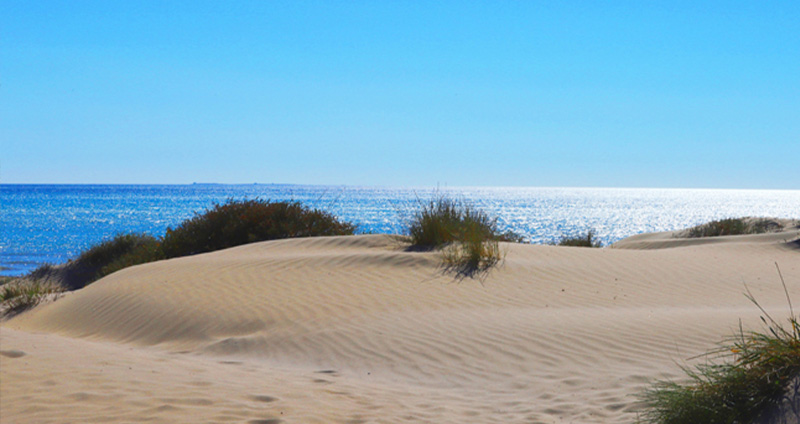
photo by: guardamardelsegura.es
These finds showed that Guardamar’s history didn’t start recently but millennia ago. The sand didn’t just bury the past—it also preserved it.
Today these sites are visitable. You can walk in the forest, suddenly standing before the ruins of a Phoenician village or at an Islamic prayer site. You understand that this place exists in layers—layers of centuries piled on top of each other, like sand.
The Pinada today – Eight hundred hectares of life
Today the Guardamar Pinada covers eight hundred hectares, divided into two parks: Parque Alfonso XIII and Parque Reina Sofía.
This isn’t just a forest. It’s a living ecosystem.
Pines, palms, eucalyptus. Beneath them, halophytic plants—those that live in salty soil—mastic, oleander, rosemary.
Birds. Many birds. Where there’s forest, there’s life.
Of course, people. The pinada isn’t a protected, untouchable area. It’s a park where people walk, run, bike, rest.
Wooden walkways lead through it. Information boards explain the story. In some places you can still see the old nursery—the Vivero Viejo—built in 1901, still operating today.
There’s also Francisco Mira’s bust, the Ingeniero Mira monument—an idealized bust showing him in his forestry gala uniform. Beneath it says: “Guardamar’s adopted son.”
When the dream comes under threat
But the story doesn’t end here. In recent years something has changed.
The pines planted more than a hundred years ago are aging. Some are dying. Due to climate change, less rain falls. The groundwater level drops. Another problem has appeared: aerosol marino—sea spray—which dries out the needles.
In 2019, a decision was made. The town and the Valencia region decided to gradually replace the pines with shrubs—mastic, blackberry, olive—plants that require less water.
This caused debate. Many Guardamar del Segura residents don’t want the forest to disappear, the forest that saved the town, the forest that was Mira’s dream.
Others say climate change is reality. We must adapt.
Today Guardamar stands at a crossroads. Will it preserve Mira’s legacy? Or let the forest transform to survive the future?
What remained
But one thing is certain. What Francisco Mira i Botella did cannot be forgotten.
He dedicated thirty years to this project. Thirty years—an entire life phase. When he finished, he was already an old man. But what he left behind is eternal.
Guardamar del Segura today is a thriving town with seventeen thousand inhabitants, eleven kilometers of beach, a forest that guards its shore.
Every January, when children go out to plant trees, Mira’s name is spoken again. The story is told again. People remember.

Francisco Mira didn’t just plant trees. He planted hope. He proved that sometimes one person is enough—one person who believes, who persists, who doesn’t give up.
When you stand today at the edge of the Guardamar del Segura Pinada, looking out at the sea where waves slowly break on the shore, then turn around to see the trees standing green and strong, for a moment you understand.
You understand that what Mira did wasn’t just engineering work. It was love. Love for a town he wanted to save. Love for life he wanted to create. Love for a future he wanted to make secure.
This love still lives here—in the trees, in the sand, in those people who still walk in this forest, perhaps not even knowing what miracle they walk beneath.
__________________________________________________
For more Costa Blanca tips, follow us on Pinterest! 🧡