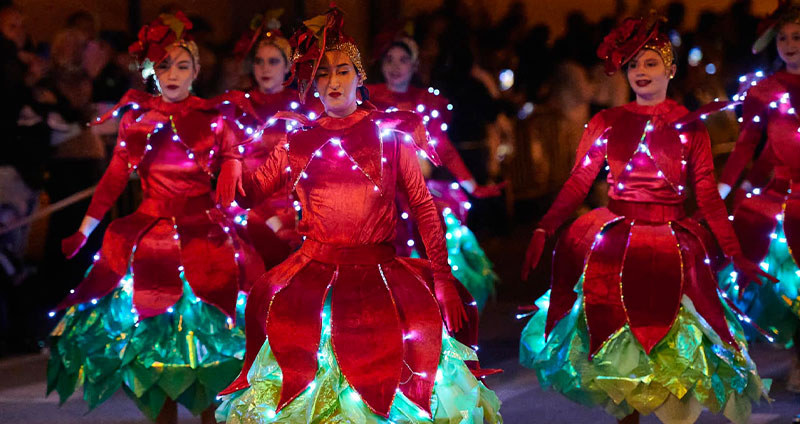
As mid-December darkness falls over Orihuela Costa, something magical begins to happen on these Mediterranean streets. The scent of hot chocolate mingles with the sea breeze, children’s chatter echoes from every direction, and if you listen carefully, you can already hear Christmas melodies from afar. This is when the southern Costa Blanca prepares for one of its most defining Christmas events, the Santa Claus Parade, which attracts thousands of people from surrounding towns year after year.
A Shopping Centre That Became a Community Space
The story began in 2012 when Zenia Boulevard opened its doors. At the time, no one would have thought that this huge shopping centre would become not only Alicante province’s largest commercial hub but also the heart of Orihuela Costa. The designers thought cleverly: they didn’t hide the shops in a closed box but shaped it into a Mediterranean town with picturesque streets, small squares, fountains and vegetation that makes the space feel homely. More than 150 shops found their place across 161,000 square metres, but what makes it truly special is the open, friendly atmosphere.
From the beginning, Zenia Boulevard’s management knew they wanted to be more than just a place where people shop. They wanted to make the centre a community space where people meet, have fun, celebrate. This is how the annual events calendar was born, in which one event soon surpassed all others: the Santa Claus Parade.
When Two Cultures Meet
Christmas in Spain has always been special, but not in the way we’re used to in the Anglo-Saxon world. Here, children traditionally receive their gifts on January 6th, when the Three Wise Men arrive. The nativity scene is the centrepiece of every home and church, and the Christmas season lasts until Epiphany.
But Orihuela Costa is different. British families live here alongside those who came from Ireland, Germany, Scandinavia, and of course with their Spanish neighbours. This multicultural environment presented organisers with a unique challenge: how to create a memorable celebration for everyone without ignoring any culture’s traditions?
The answer became a beautiful fusion. The Santa Claus Parade respects traditional Spanish Christmas customs, nativity scenes and villancicos, while embracing Anglo-Saxon Santa culture. This blend perfectly reflects what makes Orihuela Costa so special: the peaceful coexistence of different cultures, where everyone can maintain their own traditions while embracing others’.
The Magic Begins
When the parade day arrives around December 20th, the tension can be felt in the air from early afternoon. Families occupy favourable spots along the route for hours. Small children fidget beside their parents, impatiently waiting for Santa to finally arrive. Local restaurant terraces are packed, hot chocolate and churros are sold on every corner, and everyone talks about what this year’s parade will be like.
The route usually starts from the Playa Flamenca town hall office and winds through the area for more than 50 minutes. It passes through Plaza Antonio Vicea, then along Pablo Picasso street, later through Dalí and Jade streets, finally arriving at Zenia Boulevard’s central square. This 50-minute journey is enough to pass through every residential area, so everyone can participate in the spectacle.
As the start time approaches, the music gets louder. Christmas hits alternate in English and Spanish, and just when you’d think the atmosphere couldn’t be heightened any more, the first decorated floats appear.
The Magic of the Parade
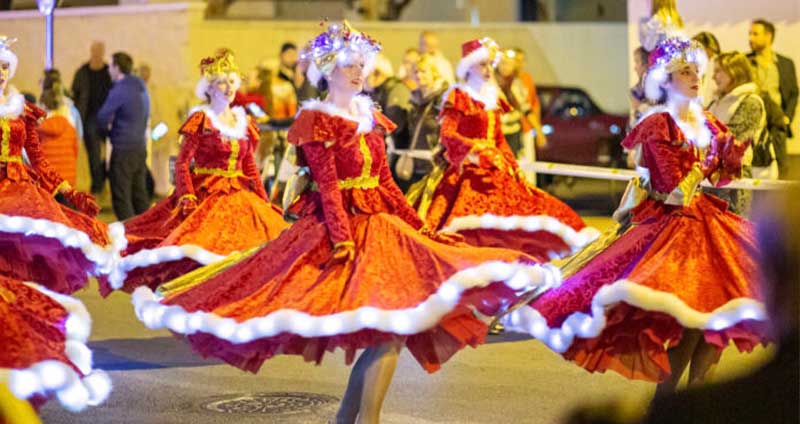
The floats look as if they’ve stepped straight out of a Christmas storybook. Snowmen wave to spectators, reindeer light up the evening darkness with their glowing noses, elves’ cottages attract attention with spinning lights. Every vehicle is decorated so that even the smallest detail is perfect. Thousands of LED lights shine, and when these pass through the streets in the early December darkness, spectators are greeted with an almost hypnotic sight.
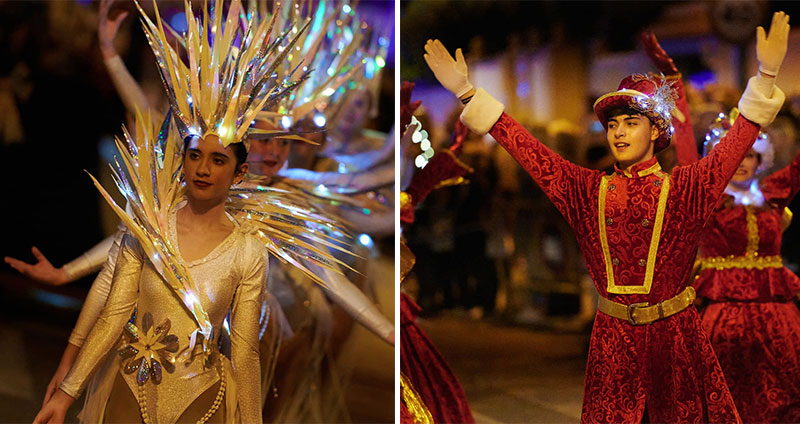
But the floats are just the beginning. Behind them come hundreds of dancers who move with such energy as if they never tire. Among them are children from local dance groups who practised for weeks to perfect every movement. Members of professional companies spin in snowman costumes, elves jump cheerfully, and soldiers march in precise rows. The choreographies are so elaborate that sometimes it feels like we’re part of a grand theatrical performance.
And then there are the jugglers playing with fire batons while Christmas melodies play in the background. Children watch them with mouths agape, some smaller children clinging to their parents’ necks to see better.
The musical accompaniment is continuous and carefully selected. Classic Christmas hits like “Jingle Bells” or “Last Christmas” sound out, but Spanish villancicos are interspersed among them, those traditional Christmas songs that have been sung in every Spanish home for generations during December. This musical mix also precisely expresses what characterises the entire event: the harmonious coexistence of cultures.
Santa’s Arrival
But all anticipation focuses on a single moment: when Santa finally arrives. The crowd quiets for a moment, then huge cheers break out when the white-bearded, red-suited figure appears on his sleigh from the North Pole. Children scream, wave, and shout “Papá Noel! Papá Noel!” so loudly it’s almost deafening.
Santa slowly proceeds along his route, waving to every child, doing so with such naturalness as if he truly were the man who visits children around the world every year. When he arrives at Zenia Boulevard’s central square, where thousands of spectators have gathered, a ceremonial reception awaits him. He’s introduced on stage, gives a speech, and announces that everyone has been good this year, so everyone can receive gifts.
Bringing the Community Together
After the parade ends, children get the opportunity to meet Santa personally. They queue patiently or impatiently, depending on each child’s temperament, and when their turn comes, they can give Santa the letter they wrote to him days earlier in a special workshop.
These letter-writing workshops usually open between December 13th and 15th at Glorieta Gabriel Miró and Zenia Boulevard. Children sit at small tables with coloured papers, stickers, glittery pens before them, and concentrate deeply on writing or drawing what they want for Christmas. Some ask for toy cars, some for dolls, some for books, but most letters contain something that goes beyond material things: that the family be together, that everyone stay healthy, that there be peace in the world.
These letters can then be handed to Santa’s elves, who solemnly promise to “forward” them to the North Pole. Of course, the children know it’s just a game, but somewhere deep in their hearts, they still believe a little in the magic. And perhaps that’s the most beautiful thing: that even in this cynical, fast-paced world, we can stop for a moment and let children be children.
After the meeting, everyone receives a mug of hot chocolate and a mini panettone, that Italian-Spanish Christmas cake without which there’s no real winter in the Mediterranean. Families sit on Zenia Boulevard’s terraces, sip the hot drink, and talk about the experience.
Santa’s Village and Other Programmes
But the Santa Claus Parade is just one part of the festive programme series. On December 21st-22nd, a special Santa’s Village opens in Zenia Boulevard’s car park. This is real Christmas magic: in small cottages, elves await children where they can wrap gifts together, make Christmas decorations, and write more letters to Santa.
The elves are so lifelike and friendly that even the most suspicious children believe they really came from the North Pole. They tell funny stories about how the millions of gifts are made, why Santa’s nose is so red, and how the reindeer can fly.
Zenia Boulevard offers a series of special programmes throughout December anyway. There are concerts every weekend where local musicians perform Christmas hits. There are craft fairs where local artisans sell their unique creations. And of course, there are children’s programmes with face painting, balloon twisting and other entertaining activities for the little ones.
Traditional Spanish Elements
Although Santa is at the centre of the parade, Orihuela Costa and neighbouring Orihuela town don’t forget traditional Spanish Christmas customs either. Impressive nativity scene exhibitions can be viewed at the town hall offices and Plaza Teniente Linares, consisting of hundreds of pieces.
These belenes, as they’re called in Spanish, aren’t simple decorations. They’re true works of art that their creators work on for months. Every figure is carefully crafted, every landscape element precisely placed. The nativity scene doesn’t just tell the story of Jesus’s birth but creates an entire world: there’s the shepherds’ camp on the hillside, the three wise men’s caravan in the distance, and in the centre, in a simple stable, the Holy Family.
Orihuela is particularly famous for these nativity scenes. The town has a centuries-old tradition in this, and many make pilgrimages here to view these masterpieces. The nativity scenes are set up in early December and remain until Epiphany, January 6th.
And yes, January 6th remains the most important day. This is when the Three Wise Men arrive, Melchior, Caspar and Balthazar, who brought gold, frankincense and myrrh to the newborn Jesus. On the evening of January 5th, there’s the Three Kings Parade, which is an even bigger event in Spain than the Santa parade. This is when children receive most of their gifts, and this is when the Christmas season truly ends.
But until then, there’s the December Santa parade, which is a kind of prelude to the holidays, a fun event that creates the Christmas atmosphere and signals: it’s time to wear warmer clothes, sip hot chocolate, and pay more attention to each other.
The Role of Solidarity
There’s something else that makes these celebrations special in Orihuela Costa: solidarity. Every year there’s a toy collection campaign where residents collect donations for families in need. Collection points are set up at town hall offices, Zenia Boulevard and other community spaces where used or new toys can be dropped off.
These gifts are then distributed among the town and Orihuela Costa’s less affluent residents. The local council ensures that every child receives something for Christmas, regardless of their family’s financial situation. This gesture reminds us that Christmas isn’t just a celebration of lights, music and entertainment, but also of giving, caring and belonging.
There are volunteers who stand outside shopping centres every December weekend, smiling and asking people to give if they can. And people give. Not because it’s mandatory, but because here, in this international community, everyone feels they’re shaping this place together, and it’s their shared responsibility to ensure everyone feels good.
Behind the Organisation
Of course, such a large event doesn’t just happen by itself. Orihuela town council’s Festivities Department begins planning months in advance. They must select the contractor who will execute the parade, close off streets, ensure first aid stations, firefighters, police. In 2024, the contract was issued with a budget of nearly 63,000 euros, a significant portion of which goes to the Orihuela Costa parade.
Based on previous years’ experiences, they continuously improve the event. If something didn’t work well, they change it. If something was particularly successful, they strengthen it. The goal is always the same: to provide every family, every child with a memorable experience.
Security measures also receive serious attention. Several thousand people gather along the parade route, and organisers must ensure no one gets hurt. There’s a separate viewing area for the youngest, where they can safely watch the parade without being swept away by the crowd. First aid stations await those who suddenly feel unwell or stumble. And of course, there are police officers who discreetly but efficiently maintain order.
The Power of Community
When the parade ends and everyone slowly heads home, something remains. Not just the memory of the beautiful floats, dancers and Santa. But the feeling that you were part of something bigger than yourself. That in this multicultural community where fifty different language speakers live side by side, there’s still something that connects them.
The parade isn’t just for children, although of course they’re the main characters. It’s also for those parents who see their children’s faces light up when they spot Santa. It’s for those elderly people who are perhaps watching their own children, grandchildren in the crowd. It’s for those immigrants who are far from home and for a moment feel at home because someone here also cares for them and celebrates with them.
Zenia Boulevard, which was once just a shopping centre, has now become the heart of the community. People meet here not because they want to shop, but because they feel at home here. They know something is always happening here: a concert, exhibition, fair, or just simply running into neighbours for a coffee.
Tips for First-Time Visitors
If you’re planning to attend the Santa Claus Parade in Orihuela Costa for the first time this year, it’s worth keeping a few things in mind. First, arrive early. The parade usually starts at 5-6 PM, but it’s worth finding a good spot hours earlier, especially if you’re going with children. The most popular spots are around Zenia Boulevard’s central square where Santa eventually arrives, but you can find a good spot anywhere along the route.
Dress warmly. Although Costa Blanca’s December weather is usually mild, it can cool down in the evening hours, especially if the wind blows. A light jacket or jumper always comes in handy, and if you’re going with children, bring them extra layers too, as they often get cold while excitedly jumping around.
Bring comfortable shoes. The parade is long, and if you want to walk along the route to see it from multiple places, you’ll need to do a lot of walking. Sometimes you have to stand in the crowd, sometimes move, and all this requires comfortable footwear.
Don’t forget your camera or phone. The colourful floats, costumes, Santa’s arrival are all wonderful photo subjects. But try to pay attention to the children too, not just stare at the camera screen. Real memories often don’t remain in photos but in the joy you see in children’s eyes.
And most importantly: be patient. You’ll need to count on large crowds, waiting, sometimes jostling. But this is all part of the experience. The holidays aren’t about everything being perfect, but about being together and enjoying each other’s company.
The True Meaning of the Celebration
When I think through this entire event, I realise that the Santa Claus Parade in Orihuela Costa means much more than what we see at first glance. It’s not just about some decorated floats passing through the streets while dancers entertain the crowd.
This event is about a community being able to come together, regardless of where they come from. About British, Spanish, German and Irish families equally excitedly awaiting Santa and equally being caught by the celebration’s magic. About there being moments when it doesn’t matter what language we speak at home, because we all feel the same joy.
And perhaps even more importantly: it creates lifelong memories for children. They’ll tell stories when they grow up about those December evenings when Santa arrived on his sleigh, when they met elves, when they drank hot chocolate on Zenia Boulevard’s terrace with their family. These memories shape them and teach them that Christmas isn’t just about gifts, but about being together, community, magic.
As local residents say: “Just step out onto the street and feel the Christmas magic in Orihuela!” And indeed, this parade offers exactly that. A chance to be part of something that connects the past’s traditions with the present’s joy and the future’s hope. A chance to feel like a child again, at least for one evening, and believe that the world is full of wonders.
When December arrives in Orihuela Costa and the countdown to the Santa parade begins, the entire area shines in a different light. The lights, decorations, music are just the surface. The real magic lies deeper: in people’s hearts, in the community’s soul, and in the hope that every Christmas can be a new beginning, another opportunity to be better, more caring, more loving.
And perhaps that’s exactly why it’s worth attending this parade. Not just to see the colourful floats or Santa. But to marvel again at how beautiful life can be when we celebrate together.
For more Costa Blanca tips, follow us on Pinterest! 🧡
photos by: Alexander Pichlmayr