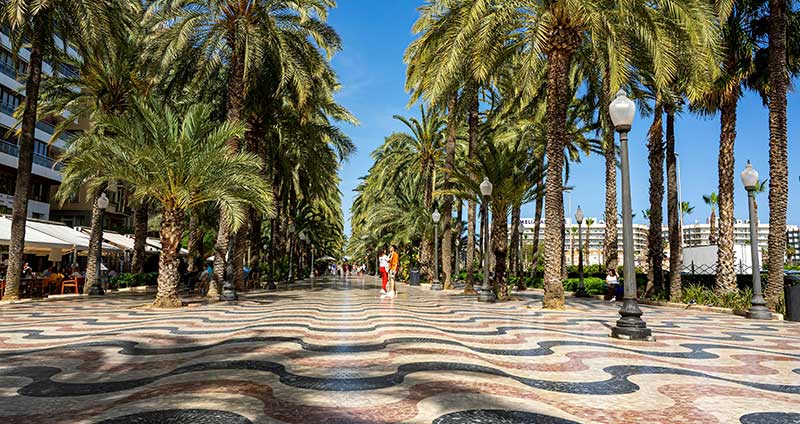
There’s something special about walking along Alicante’s most famous promenade, the Explanada de España, for the first time. In the shade of palm trees, in the breeze of the Mediterranean Sea, you walk, and beneath you the ground undulates. No, you’re not dreaming, and it’s not an earthquake either – this magical effect is thanks to 6.5 million tiny marble mosaic tiles that create a stunning, wave-like pattern. This promenade is not just a thoroughfare or tourist attraction; it’s the heart and soul of Alicante, an artistic creation that has enchanted those who walk along it for decades.
The story that brought the sea to land
The story of Explanada de España dates back to the early 20th century, an era when the city of Alicante was dynamically developing and seeking its architectural identity. The idea of creating the promenade emerged in the late 19th century, but it took its current form in the 1920s and 1930s.
Before this beautiful promenade came into being, the area was a rather flat, characterless port section. However, the city’s leaders had ambitious plans: they wanted to create a representative promenade worthy of Alicante’s Mediterranean charm and strategic port significance. They didn’t just want a functional public space, but something special, something that would capture the essence of the city.
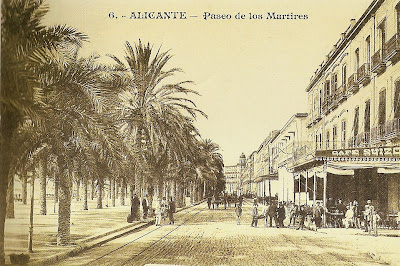
photo by: alicantevivo
The project’s realization fell to José Guardiola Picó, a local architect and engineer who was born in Alicante in 1867. Guardiola was not unknown in the city – he had already worked on numerous significant projects and knew well Alicante’s character, needs, and possibilities. When he received the commission to design the Explanada, he knew he had to create something truly memorable.

José Guardiola Picó
The art of design and the birth of a vision
Guardiola’s vision was guided by one thing: the Mediterranean Sea. Alicante had always lived from the sea, the sea was its life force, part of its identity. The designer therefore decided to bring the sea itself to the promenade – not literally, but symbolically, artistically.
The mosaic pattern was not a random or merely decorative choice. Guardiola wanted to represent the waves of the sea – that eternal movement, that dynamism that never stops, that constantly changes yet is eternal. During the design process, he chose three colors: red, cream, and black. These colors were not selected solely for aesthetic reasons.
The red marble was brought from Alicante province, specifically from the nearby town of Novelda. The use of this local stone was not just a practical decision – it was also a matter of identity. A promenade built from the city’s own stone, representing local pride and regional traditions.
The cream-colored marble was transported from the famous marble region of Markina in the Basque Country. The black marble also originated from northern Spain. The combination of the three colors is not only visually stunning but also symbolic: it unites different regions of Spain in a single artistic creation, reflecting the country’s diversity and unity.
The geometry of waves
The mosaic pattern – created using the “trencadís” technique – truly forms waves. But these are not chaotic, disorderly waves. Guardiola created a carefully designed, geometric wave pattern that creates an optical illusion. When you walk along the promenade, it seems as if the ground beneath you is truly undulating, as if the sea itself were there, right under your feet.
This effect is achieved by the alternation of colors and the repetition of patterns. The precisely placed rows of red, cream, and black tiles create wide, swirling lines that run parallel along the promenade, yet create a dynamic, moving sensation. From a distance, you can almost see the waves rolling, though of course every stone is perfectly still.
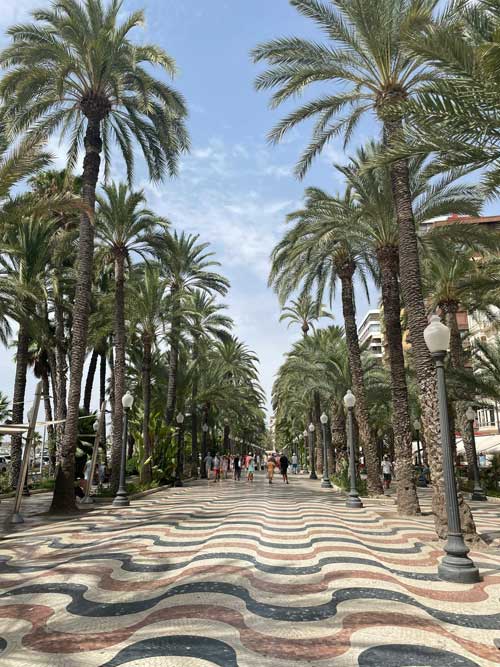
The design was not a simple task. Each small marble tile had to be cut, shaped, and placed by hand. The work took years and required an enormous workforce. But the result? Priceless. A public space was created that has captivated people for generations and has become one of Alicante’s most iconic symbols.
Where exactly is it located and how long is it?
The Explanada de España is located in Alicante’s historic center, right next to the port. The promenade is approximately 500 meters long and connects Canalejas Park with the southern part of the port. If you arrive in the city of Alicante, it’s almost impossible not to encounter this wonderful promenade – it’s the backbone of the city, the central artery.
As soon as we step onto the promenade, the first thing that strikes us is the long row of palm trees. Four rows of palm trees line the Explanada, more than 300 trees in total, providing shade on hot summer days and creating a special Mediterranean atmosphere. Under these palm trees are small benches where people rest, chat, children play, musicians perform, artists paint.
On the northern side of the promenade is the Real Club de Regatas de Alicante, a historic sailing club building, as well as numerous cafés, restaurants, and shops. On the southern side is the port itself, where yachts and small boats bob on the water. This duality – the bustle of city life on one side, the calm of the sea on the other – is what makes the Explanada so special.
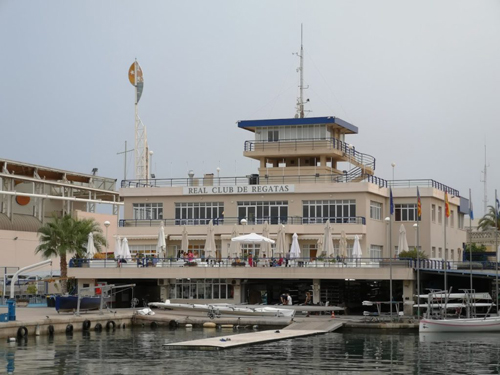
Real Club de Regatas de Alicante
Symbolism and significance
The mosaics of Explanada de España mean more than mere decoration. These small marble tiles are part of Alicante’s identity, symbolizing the city’s connection to the sea, which has determined its fate for centuries.
The undulating pattern represents the eternal movement of the Mediterranean Sea – the element that gave life to this city. Alicante was a port city, a commercial center where different cultures met, where goods, information, and people flowed through the sea. The rhythm of the mosaic waves reflects this dynamism: constant change, movement, life.
But there is also a deeper symbolism. The three colors – red, cream, and black – are not just an aesthetic choice but also a cultural one. Some believe that these colors represent different aspects of Spanish identity: red for passion and energy, cream for Mediterranean sunshine and warmth, black for the depth and seriousness of history.
Others suggest that the three colors simply represent different states of the sea: calm water, choppy seas, and stormy depths. Whichever interpretation we choose, what is certain is that this mosaic is more than decoration – it’s a narrative, a story that the city tells the world.
The Explanada through the decades
Since the construction of Explanada de España, it has been the center of Alicante’s social life. Generations have walked along this promenade, generations have experienced the most important moments of their lives here. Couples’ first dates, families’ Sunday afternoon walks, tourists’ amazed glances – all of this has taken place on the Explanada’s mosaics.
Over the decades, the promenade has of course changed and evolved. Renovations, maintenance, modernizations – all done in a way that preserved the original character and the integrity of the mosaic. It’s no easy task to maintain more than six million tiny marble tiles, especially in a place where tens of thousands walk over them daily.
In the 21st century, there have been several significant renovation projects aimed at preserving the Explanada for future generations. Local authorities are aware that this is not just a promenade – it’s cultural heritage, an artistic treasure that must be protected and cared for.
Life on the Explanada today
Today, Explanada de España is one of Alicante’s liveliest locations. Early in the morning, runners use it for training, the smoothly polished marble providing a pleasant surface. In the morning, arriving tourists admire the pattern, take photos, and try to understand the optical illusion of the waves.
In the afternoon, local families arrive with children. Kids run around among the mosaics, parents rest in the shade of palm trees, eating ice cream, chatting. Street artists bring out their tools – musicians play, painters set up easels, living statues stand motionless.
As evening falls, the Explanada takes on a special atmosphere. The sunset light turns the mosaics golden, café terraces fill with people sipping a glass of red wine or sangria while watching the sun set over the port. This is when you truly feel why this place is so special.
On weekends and holidays, the Explanada becomes even livelier. Markets set up under the palm trees, selling handcrafted products, jewelry, and local specialties. This promenade is also the venue for special events, festivals, and concerts, transforming into a huge community space on these occasions.
Why is it worth visiting?
If you live on the Costa Blanca or visit here, Explanada de España is a must-see. Not just because it’s beautiful – though it certainly is – but because this place encapsulates everything that makes Alicante Alicante. The sea, the history, the art, the community.
When you walk along this mosaic-covered promenade, you’re not just taking a tourist’s path. You’re participating in a tradition more than a hundred years old, connecting with the soul of the city, understanding why this place is so special to the locals.
Bring comfortable shoes and take your time. Sit on one of the benches under the palm trees, pay attention to the life happening around you. Watch how children play among the mosaic patterns, how elderly couples walk hand in hand, how tourists take photos. All of this is part of the Explanada, all of this creates that magical atmosphere.
And if you can, return at different times of day. In the morning, when the city is still waking up and the sun’s first rays glisten on the marble mosaics. At noon, when the Mediterranean sun shines at full strength and the palm trees’ shadows draw stripes on the undulating pattern. In the evening, when the lamps light up and a completely different, romantic mood takes over.
The heritage that must be preserved
The mosaics of Explanada de España are part of the cultural heritage not only of Alicante but of all of Spain. José Guardiola Picó’s vision, which he dreamed up in the 1920s, is still respected and preserved in the 21st century. This creation proves how art, function, and community space can become one, how they can create something timeless and truly significant.
Every small marble tile that makes up this enormous undulating sea is part of a story. Every step we take on it connects us with those who came before us – with past generations who walked, dreamed, and lived their lives in this same place.
The mosaics of Explanada de España are more than a beautiful promenade. This is a living work of art, a community space, a historical monument, and a declaration of love for the sea. This is the heart of Alicante, beating every day, with every step that people take on the undulating marble mosaics.
If you ever pass by, stop for a moment. Look down at your feet and admire this incredible creation. And then lift your gaze, look around, and see how this place lives, how it fulfills its role in the heart of a vibrant, Mediterranean city. Because Explanada de España is not just the past – it’s also the present, and hopefully a defining future for many more generations to come.
__________________________________________________
For more Costa Blanca tips, follow us on Pinterest! 🧡