The Moorish Legend – The Face on the Mountain
Every visitor to Alicante notices it at first glance: the rock formation of Mount Benacantil draws the outline of a face against the sky. This is “El Rostro del Moro” – the Face of the Moor, which eternally gazes at the heavens, waiting for something… or someone.
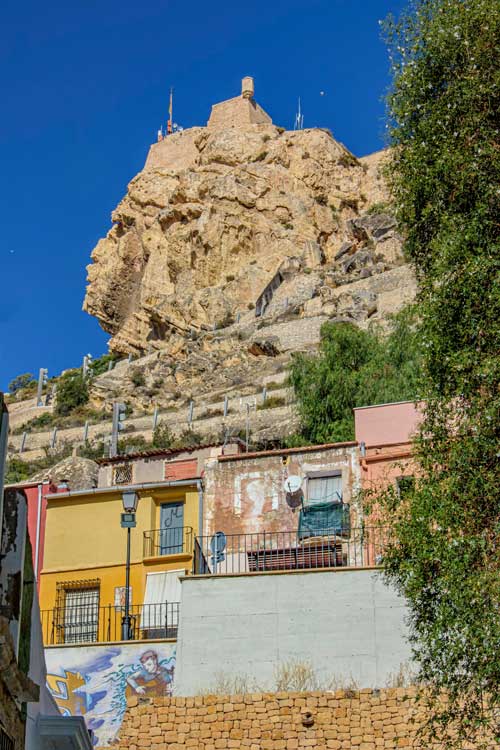
The legend reaches back to the Middle Ages, when the Moors still ruled this region. Caliph, a young Moorish prince known for his wisdom and justice, fell in love with a beautiful Christian girl, Cántara. Their love was secret, dangerous, as it stretched between two hostile worlds, where religious and cultural differences carved an unbridgeable chasm between people.
Cántara’s father, an influential Christian nobleman, discovered his daughter’s forbidden love. In his fury, he determined to rid himself of the young Moorish prince. One night, when Caliph was waiting near the city wall for his beloved, soldiers attacked him. The prince knew that if captured, not only his life was in danger, but Cántara’s as well.
In desperation, he fled to the mountain peak, toward the Santa Bárbara castle. But the soldiers were close on his heels. At the mountain’s summit, when there was nowhere left to go, he cast one final glance at the city where his love lived, then threw himself into the depths.
They say that in the moment his body reached the rocks, the mountain moved. The stones slowly rearranged themselves, and Caliph’s face was forever carved into the cliff. Now he still gazes at the sky, in eternal waiting, hoping to meet his love once more.
As for Cántara, when she learned what had happened, she climbed to the mountain’s peak every day. She sat there for hours, watching the sea, weeping. Finally, on a stormy night, she too followed her love into the depths. Locals say that if you listen carefully at the mountain’s summit, you can still hear Cántara’s crying in the wind.
The Ghost of Santa Bárbara Castle
The Santa Bárbara castle standing atop Mount Benacantil is not only one of Alicante’s most important historical buildings, but also the setting for numerous ghostly tales. One of the most famous is the legend of the White Lady.
In the sixteenth century, the castle’s commander, Don Fernando de Alarcón, raised his beautiful daughter Isabella alone after his wife died in childbirth. Isabella was beautiful and intelligent, but her father jealously guarded her, shutting her away from the world within the castle’s high walls.
One day a young soldier arrived at the castle, Diego de Montalvo. He was brave, honest, and his heart was pure. Between Isabella and Diego, sparks flew immediately, and they met secretly in the castle’s hidden corners, in the shadows of the bastions on moonlit nights.
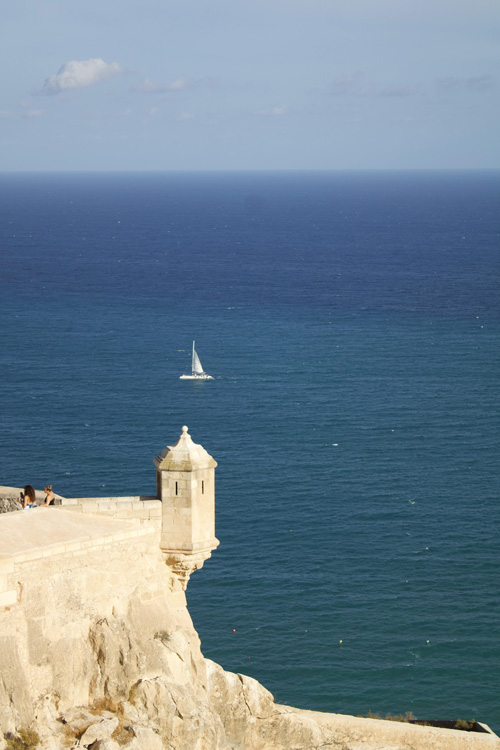
When Don Fernando learned of this, his rage was boundless. He commanded that Diego be locked in the castle’s deepest dungeon, a damp, dark cell from which no one had ever returned alive. Isabella begged her father, but the commander’s heart was harder than the castle walls.
Every night, Isabella rushed down to the prison where Diego languished. Through the thick stone walls they whispered to each other, declared their love, and wove plans of escape. But days passed, and Diego grew weaker.
On a moonless night, Isabella stole a key and rushed down to free her beloved. But it was too late. Diego was no longer breathing. The girl’s pain was so deep that her heart shattered. In her white dress, she collapsed beside her love’s body, and never rose again.
According to the story, Isabella’s ghost has haunted the castle ever since. Her white-clad figure has been seen countless times, wandering the corridors, searching for something… or someone. She is especially visible on full moon nights, when she stands on the bastions gazing at the city. They say that whoever hears her crying will be unhappy for three days.
The Stones of the Explanada – Memory of the Sea
The Explanada de España, one of Alicante’s most iconic promenades, offers a stunning sight with its undulating pattern made from more than six million marble stones. But few know that these stones also have their legend.
Long ago, when only sand and stones lay where the promenade now stands, an old fisherman named Pedra lived on the shore. Pedra went out to sea every day and returned home every evening to his wife, Rosa. Their marriage was happy, but heaven did not bless them with children.
One day, when Pedra sailed out to sea, a massive storm arose. The waves were as tall as a house, and the wind so strong it tore the sails. Pedra’s boat capsized, and the fisherman plunged into the depths.
In the sea’s depths, when he felt it was the end, a strange light appeared before him. A beautiful sea nymph swam toward him, her long green hair floating in the water, her eyes shining in the deepest ocean blue.
“Pedra,” the nymph spoke to him, “I will save your life, but in exchange I ask a service. Gather for me a thousand colored stones from the seashore. Let each stone equal a wish, and place them in a pattern that reminds one of waves. Thus the sea will always be close to the city, even when it is far away.”

Pedra promised, and the nymph cast him safely ashore. When Rosa saw that her husband lived, she cried with joy. Pedra told her the story, and from the next day they collected stones every day. Pink, white, gray and black stones, each unique, each of different shape.
Years passed. Other fishermen joined them, then craftsmen, merchants, children. The whole city helped. And slowly, slowly, the most beautiful promenade was completed, which with its undulating pattern recalled the sea.
They say that whoever walks the entire length of the Explanada and whispers a wish with each step will have their dream fulfilled. But only if their heart is pure, and their wish brings joy to others as well.
Pedra and Rosa never had children, but the whole city became their family. And when they died, a statue was erected to them at the end of the Explanada, where they still stand, holding hands, forever watching the sea.
The Hidden Crypt of San Nicolás Cathedral
The Concatedral de San Nicolás de Bari, Alicante’s beautiful baroque cathedral, conceals a dark secret in its depths. According to legend, beneath the church lies a hidden crypt that leads to a treasure no human eye has ever seen.
The story comes from the seventeenth century, when Alicante was threatened by pirates. The city was home to wealthy merchants and nobles, and enormous amounts of gold and silver had accumulated in the church from donations and offerings.
One night a mysterious monk arrived in the city. No one knew where he came from, and no one knew him. But his wisdom and knowledge were impressive. The city leaders entrusted him to build a secret crypt beneath the church, where the treasures would be safe from pirates.
The monk worked for months, alone, at night. No one saw what he was doing. Strange music could be heard from the church’s depths, and peculiar lights flickered through the windows. People began to whisper – perhaps the monk was working with magic?
When he finished, the monk called together the city leaders and showed them the crypt. Labyrinthine corridors led downward, full of traps and puzzles. At the very end stood a massive door, covered with strange symbols.

photo by: spain.info
“This door will only open,” said the monk, “if three pure-hearted people wish it simultaneously. If greed, vengeance, or evil is in any of their hearts, the door will remain forever closed, and the crypt will collapse.”
Then the monk disappeared, as suddenly as he had arrived. They never saw him again. The city fathers decided to seal the crypt forever, and leave the treasures inside, safe.
Since then, countless adventurers have tried to find the crypt. They made maps, searched underground passages, but no one found it. Some say it’s because their hearts were not pure. Others say it’s because the crypt doesn’t actually exist, it’s only a legend.
But the locals know the truth. At night, when the moon is full and the cathedral’s shadows lengthen, strange lights can be seen around the church. And sometimes, if you listen carefully, you can hear singing from the depths – the monk’s incantation still guards the secret.
The Musician of Rambla Street
The Rambla de Méndez Núñez, one of Alicante’s busiest promenades, also conceals a touching legend. This is the story of a blind musician who lived in the city in the nineteenth century.
Miguel was born blind, but heaven gave him a special gift – music. He played his guitar with such virtuosity that whoever heard it was moved to tears. His songs were about love, loss, hope, and every note radiated deep emotion.
Miguel sat in the same spot every day on the Rambla, under a giant plane tree. People stopped, listened, threw money in his hat, but Miguel didn’t play for money. He played for a girl he had never seen but loved deeply.
He met Carmen – or rather didn’t meet her – on a spring morning. He heard Carmen’s voice. The girl walked past him singing, and her voice was as clear as morning dew. Miguel knew immediately that this was the voice he had always been searching for.
For days he waited for Carmen to pass by again. And when he heard her singing once more, he joined in with his guitar. Carmen stopped, listened, and something wonderful happened. Their melodies intertwined, as if they had been created for each other.
From that day on, they made music together every afternoon. Carmen sang, Miguel played guitar, and the Rambla filled with music and joy. People came from far away to hear them. They said their love was so strong that even the blind could see it.
But happiness did not last long. Carmen was born wealthy, and her family did not look kindly on her spending time with a blind street musician. One day Carmen’s father sent his daughter away, far away to another city, where she would never again hear Miguel’s music.
Miguel waited for Carmen’s return for weeks. Every day he sat under the plane tree, played guitar, and hoped that Carmen would hear and return. But the girl never came back.
They say that Miguel died there under the tree, with his guitar in his hands. And since then, if you walk on the Rambla on a quiet evening, you can sometimes hear the sounds of a guitar in the wind. Miguel’s song, which forever searches for Carmen.
The Legacy
Alicante’s old town is filled with these legends. Every street, every square, every building conceals a story. These tales do not merely entertain – they remind us that the past is always with us, that love is stronger than death, that hope never dies.
When you walk through the city’s streets and tread upon the old stones, think of Caliph, who died for his love, of Isabella, who still searches for her beloved, of Pedra and Rosa, who gave the city the sea’s gift, of the mysterious monk who guards the city’s treasures, and of Miguel, who still plays for his love.
These legends form Alicante’s soul. And as generations have passed them down, we too carry them forward, so that we never forget: stories sustain us, connect us with the past, and show us the way to the future.
Alicante’s old town lives. And in every stone, a story waits to tell itself to those willing to listen.
__________________________________________________
For more Costa Blanca tips, follow us on Pinterest! 🧡