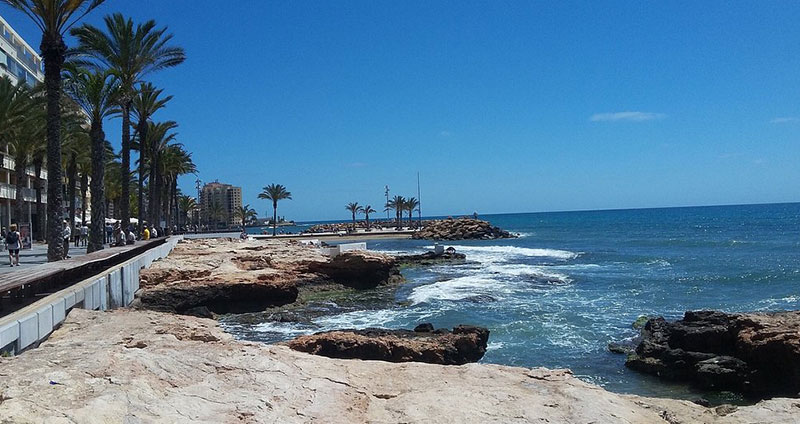
There’s a beach in the heart of Torrevieja that carries a name heavy with memory. Playa del Cura—the Beach of the Priest. Walk along its golden sand today, watch families building sandcastles, hear the laughter of children in the shallow waters, see couples strolling the promenade at sunset. You’d never guess this place was named for a death. For a tragedy that shook a small fishing town over 150 years ago.
But that’s the paradox of Playa del Cura. A place marked by loss has become a symbol of life. A beach born from sorrow has become the beating heart of Torrevieja.
When Torrevieja was nothing
To understand Playa del Cura, you have to understand what Torrevieja was in the 19th century. Nothing. Almost nothing.
A scattering of cottages. A few fishermen’s huts. An old watchtower—the Torre Vieja—standing guard against pirates who’d long since stopped coming. Salt pans shimmering pink under the relentless Mediterranean sun. That was it.
The town itself was barely a town. Until the 1800s, this stretch of coast was just empty land punctuated by desolate dwellings. Then in 1803, King Charles IV made a decision that would change everything: he ordered the salt production operations moved from nearby La Mata to this forgotten corner of the coast.
Suddenly, Torrevieja had a purpose.
Workers came. Families settled. A port took shape. By the mid-1800s, ships were sailing from Torrevieja to Cuba, to Havana, to Santiago de Cuba, carrying salt in their holds. They returned with sugar, coffee, hardwoods. Music too—those slow, nostalgic melodies called habaneras that Cuban sailors sang, which Torrevieja’s men brought home like treasures.
The town was growing. But it was still small. Still a place where everyone knew everyone. Where a tragedy didn’t just happen to one person—it happened to the whole community.
The day the priest drowned
Sometime before 1870, a priest came to this beach to bathe.
That’s all we know for certain. We don’t know his name. We don’t know if he was young or old. We don’t know if he was a local priest who’d served in Torrevieja for years, or a visiting cleric from Orihuela or Alicante.
What we know is this: he went into the water. Perhaps it was a hot summer day. Perhaps he’d walked down from the church through streets that barely existed yet, eager for the relief of cool seawater. Perhaps he was a strong swimmer, confident in the Mediterranean’s embrace.
But something went wrong.
Maybe a current caught him. Maybe cramps seized his legs. Maybe the wind shifted, bringing unexpected waves. The sea can be gentle one moment, treacherous the next. Anyone who’s lived by the Mediterranean knows this.
The priest drowned.
His body was pulled from the water. The news spread through the tiny fishing village like wildfire. A priest, drowned. A man of God, taken by the sea that gave Torrevieja its livelihood but also claimed its toll.
The community was devastated. In a town of perhaps a few hundred souls, everyone felt the loss. Everyone knew him, or knew someone who knew him. In a fishing village where men faced the sea’s dangers every day, this death wasn’t just tragic—it was a terrible reminder of mortality.
They needed to remember. To mark the place. To ensure this loss wouldn’t be forgotten.
So they gave the beach his name. Not his actual name—that’s been lost to history. But his calling. Playa del Cura. The Beach of the Priest.
By 1870, it was official. Nautical charts recorded it: Playa del Cura. A name born from drowning, fixed onto maps that would guide sailors for generations.
The Earthquake that changed everything
But naming a beach couldn’t protect the town from what came next.
March 21, 1829. Before the priest drowned, before Torrevieja even had a proper beach to name, the earth shook.
A massive earthquake—6.6 on the Richter scale—tore through the Vega Baja region. The nearby town of Almoradí was destroyed. Torrevieja suffered devastating damage. The old watchtower—the Torre Vieja that gave the town its name—was partially destroyed.
Everything had to be rebuilt. The town was reconstructed almost from scratch, rising from the rubble with a new grid street plan, new buildings, new hope.
This was the Torrevieja the priest would have known. A town rebuilt. A town that understood loss. A town that had already faced destruction before that tragic drowning gave Playa del Cura its name.
How a fishing village became a town
Throughout the 19th century, Torrevieja’s economy rested on three pillars: salt, fish, the sea.
The salt works were everything. By the mid-1800s, hundreds of ships were registered in Torrevieja’s harbor. In just two years—1844 and 1845—772 ships set sail from this small port. Most headed to Cuba.
The sailors who worked these routes weren’t just transporting salt. They were building connections. Creating a culture. Those habaneras they brought back from Havana weren’t just songs—they were pieces of a wider world, threads connecting this tiny Spanish fishing village to Caribbean ports thousands of miles away.
Fishing remained vital. By the 19th century, Torrevieja had the largest fishing fleet on the Valencia coast. Fresh fish sustained the community when other supplies were scarce. The Mediterranean provided.
The town grew slowly. A few thousand residents. Simple people working the huerta, casting nets, loading salt onto ships. A church. A plaza. Streets that turned to dust in summer, mud in winter.
Playa del Cura was there all along. Just a small stretch of coastline. A cove where fishermen might beach their boats. Where families might wade in the shallows on hot days.
Where a priest once drowned.
The transformation
For decades, Playa del Cura remained what it had always been: a working beach in a working town. Functional. Unremarkable except for its name.
Then the 20th century arrived.
Torrevieja began to change. The salt trade continued—the lagoons still produced hundreds of thousands of tons annually. The fishing fleet endured. But something new was happening.
Tourism.
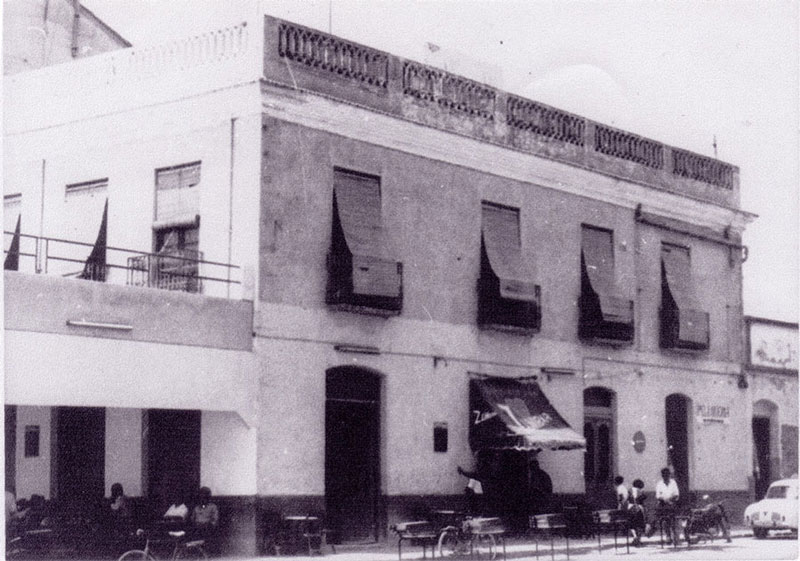
Café España, 1960 | photo by: pescatorrevieja
It started slowly in the 1960s. First came the Swedes, drawn by the climate, the sunshine, the dramatic difference from Scandinavian winters. Then Germans. British. The construction boom began. Hotels rose. Apartments multiplied. The population exploded.
By 1991, Torrevieja had 25,000 residents. Two decades later, nearly 100,000. Today, over 130 nationalities call this place home.
Playa del Cura transformed along with the town. No longer just a fishermen’s beach, it became Torrevieja’s central beach—its showcase, its heart, its soul.
The promenade was built. Renovated. Renovated again. Palm trees were planted. Restaurants opened. Beach bars appeared. Infrastructure arrived—showers, toilets, lifeguard stations, accessible bathing areas for people with reduced mobility.
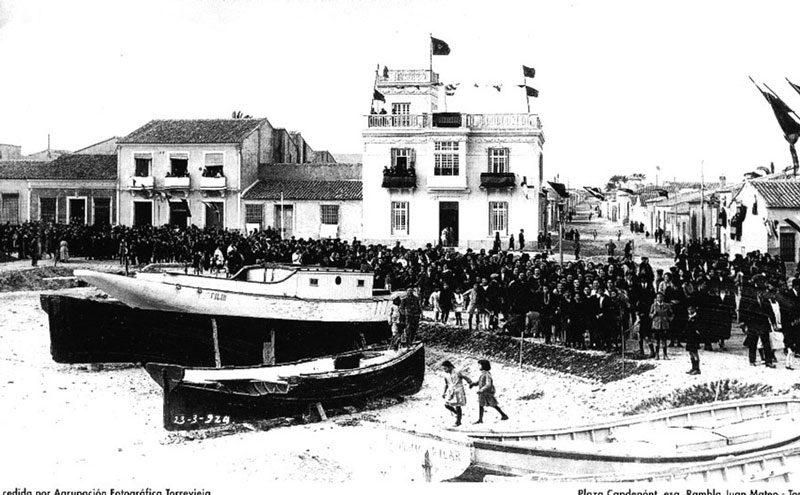
photo by: Torrevieja Photographic Association
The beach itself—325 meters long, 27 meters wide—gained recognition. Blue Flag awards. ISO certifications for environmental quality. Qualitur distinctions.
But more than awards, Playa del Cura gained something else: identity. It became the place where Torrevieja shows itself to the world.
The social soul of Torrevieja
Visit Playa del Cura on a summer morning. Arrive around eight or nine, before the crowds descend.
You’ll see groups gathering for exercise sessions, moving to music on the sand. Families claiming their spots, children already impatient for the water. The promenade filling with early walkers enjoying the Mediterranean climate. Beach bars opening their shutters, preparing coffee for those who want breakfast with a view.
The beach has a rhythm. Different energies at different times.
Mornings belong to families. The shallow, calm waters make it perfect for children. The gentle slope means even small kids can wade safely while parents watch from the shore.
Afternoons—especially from noon to five in July and August—the beach reaches capacity. Every umbrella spot claimed. Every meter of sand occupied. This is when Playa del Cura shows its challenge: it’s popular precisely because of its central location, which means finding space can be nearly impossible during peak season.
But wait. Watch what happens as the sun begins to set.
The families pack up. The daytime crowds thin. The beach transforms.
Couples appear. Groups of friends. People who’ve come not to swim but to sit on the sand, to watch the sky turn gold and orange and purple over the Mediterranean. The promenade becomes a stage for the traditional evening paseo—that quintessentially Spanish ritual of walking, seeing, being seen.
This is when Playa del Cura reveals its true nature. Not just a beach, but a social space. The beating heart of Torrevieja’s communal life.
When music fills the sand
Every summer, something magical happens on Playa del Cura.
Tables and chairs appear on the sand. Hundreds of them. People arrive carrying picnic baskets, bottles of wine, fresh watermelon. They settle in as the sun sets, as the first stars appear, as the Mediterranean darkens from blue to black.
Then the music begins.
Habaneras. Those slow, nostalgic melodies that Torrevieja’s sailors brought back from Cuba 150 years ago. Songs that speak of the sea, of longing, of love and loss. Songs that are woven into this town’s DNA.
The Night of Habaneras on Playa del Cura—now in its 29th year—is more than a concert. It’s a tradition. A cultural touchstone. An annual reminder of who Torrevieja was, who it is, who it wants to be.
Choral groups perform. Local groups like “Brea y Sal.” Visiting groups from across Spain. Children’s choirs. The voices rise over the water, accompanied by waves breaking on the shore, Mediterranean breezes carrying the melodies up the promenade.
This event serves as a prelude to the International Habaneras and Polyphony Contest—one of the most prestigious events of its kind in Spain, running since 1955. But the beach concert has its own character. Less formal. More intimate. A celebration that happens right where the priest drowned, where tragedy became a name, where loss became memory.
People don’t come just to listen. They come to participate in something larger than themselves. To connect with tradition. To feel part of Torrevieja’s story.
The monument to mediterranean cultures
Walk to the northern end of Playa del Cura, toward Punta Margalla (also called Punta Carral), you’ll find them.
Las Columnas. The Monument to the Cultures of the Mediterranean.
Tall white columns rising against the blue sky, geometric forms playing with light and shadow. Probably the most photographed spot in all of Torrevieja.
Tourists cluster here for selfies. Wedding photographers bring couples for sunset shots. Influencers strike poses.
But the monument means more than aesthetics. It represents what Torrevieja has become: a meeting place. A crossroads. A town where 130 nationalities coexist, where Mediterranean cultures blend and overlap, where the past and present stand side by side.
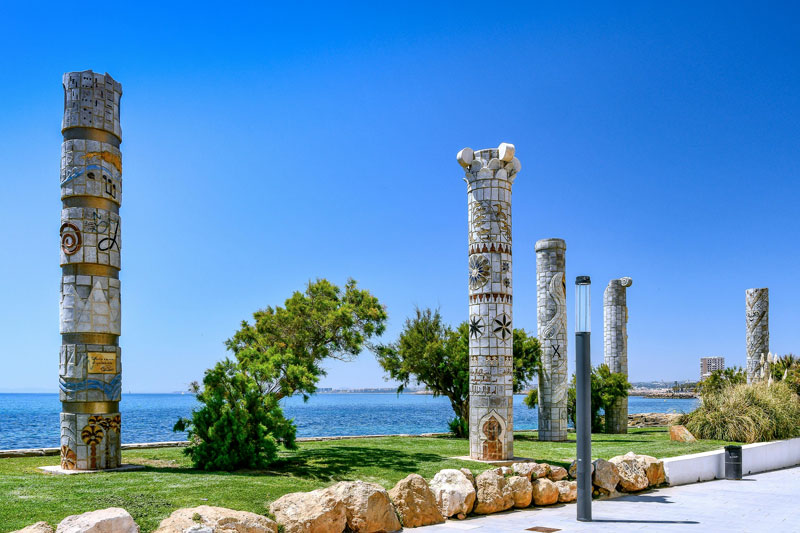
From this spot, you can see the entire beach. The curve of sand. The promenade lined with palms. The restaurants with their outdoor terraces. The people—so many people, from so many places.
This is Torrevieja now. Not a small fishing village. Not just a salt town. Something bigger. More complex. International.
Yet still marked by that 19th-century tragedy. Still carrying a priest’s memory in its name.
What remains
Today, Playa del Cura faces the challenges all urban beaches face.
Overcrowding in summer. Complaints about umbrellas claimed at dawn by people who don’t arrive until noon. Occasional problems with cleanliness—despite daily maintenance, the sheer number of visitors takes its toll.
Some visitors complain. Say it’s too crowded, too commercial, too loud. Say you should go to quieter beaches if you want peace.
They’re not wrong. But they’re missing the point.
Playa del Cura was never meant to be a tranquil escape. It’s a city beach. A social beach. A place that reflects Torrevieja’s energy, its diversity, its vitality. The crowds are the point. The activity is the point.
This is where Torrevieja comes to see itself. To celebrate itself. To be itself.
Walk here in winter—when the summer hordes have gone, when only locals remain—it’s a different place. Quieter. The promenade becomes a genuine pleasure for walking. The beach feels spacious. You can actually hear the waves.
But even then, even in the quiet season, the name remains. Playa del Cura. The Beach of the Priest.
The weight of a name
Over 150 years have passed since a priest drowned here. Generations have come and gone. Torrevieja has transformed beyond recognition—from a tiny fishing village to a thriving cosmopolitan city of 80,000 permanent residents, swelling to many times that in summer.
The beach has been modernized, renovated, awarded, photographed, reviewed, celebrated, criticized.
But the name hasn’t changed.
Playa del Cura.
It’s a reminder of something important: that places carry memory. That tragedy doesn’t just disappear. That loss can be transformed—not erased, but woven into something larger.
The beach that was named for a drowning has become a place of life. Where children play. Where families gather. Where music rises over the water on summer nights. Where people from 130 nations come together under the Mediterranean sun.
The priest whose name was forgotten is still here, in the beach that bears his calling. Not in sorrow, but in celebration. His death marked this place. But it didn’t define it.
What defines Playa del Cura now is what it has become: the soul of Torrevieja. A place where the sea meets the city. Where tradition meets modernity. Where loss meets renewal.
When you stand on this beach, toes in the sand, looking out at the endless blue of the Mediterranean, you’re standing where he drowned. Where Torrevieja chose to remember. Where a name became a legacy.
Every wave that breaks on this shore carries that story. Every habanera sung here echoes with it. Every sunset watched from the promenade reflects it.
Playa del Cura. The Beach of the Priest.
Where tragedy became a name. Where a name became a place. Where a place became a heart.
Where Torrevieja lives.
__________________________________________________
For more Costa Blanca tips, follow us on Pinterest! 🧡