There are moments when history breaks clean. When everything before becomes “then” and everything after becomes “now.” For Almoradí, that moment came at 6:15 in the evening on March 21, 1829.
The earth moved.
Not gently. Not briefly. But with a violence that would reshape the entire Vega Baja del Segura region, claiming lives, destroying towns, transforming the landscape forever.
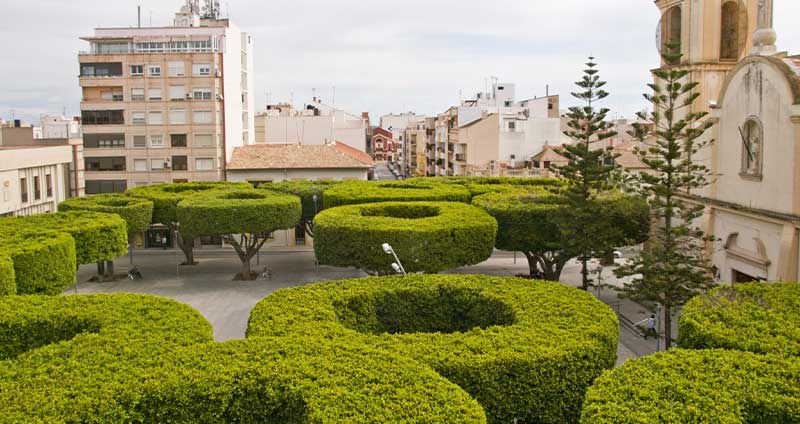
Today, when you walk through Almoradí’s orderly streets, when you admire the town’s unusual grid pattern, when you notice how the buildings sit low and solid, you’re walking through a ghost. The Almoradí that existed before that March evening is gone. Completely. What stands here now is something else entirely—a town built from rubble, designed from tragedy, rising from one of Spain’s most devastating earthquakes.
This is the story of how a town died in minutes. How it was reborn over years. How disaster became the foundation of everything that followed.
The decade the Earth wouldn’t stop moving
The 1820s were restless years in southeastern Spain.
The ground trembled. Often. The people of the Vega Baja grew accustomed to minor earthquakes—those brief shudders that rattled dishes, cracked plaster, sent chickens squawking. Annoying. Unsettling. But survivable.
Between September 1828 and March 1829, nearly 200 tremors were recorded. Think about that. Two hundred earthquakes in six months. The earth beneath Alicante province was like a beast slowly waking.
Some towns, like Guardamar, hadn’t even finished repairing damage from an 1823 earthquake when the sequence began. They were still rebuilding when the next wave hit. Still vulnerable. Still exposed.

photo by: alicantevivo
The people noticed. How could they not? But what could they do? You can’t move a town. Can’t stop an earthquake. You pray. You repair. You hope the worst has passed.
In Almoradí, life continued. A market town in the fertile Segura River valley. Narrow medieval streets where neighbors could almost shake hands from opposing windows. Multi-story buildings—rare in this region—housing extended families, shops on the ground floor, living quarters above. A prosperous place. Densely built. Ancient.
The ground kept shaking.
6:15 PM: When the World ended
Saturday, March 21, 1829. Late afternoon settling into evening.
Families preparing dinner. Shops closing. The day winding down toward that peaceful moment when work stops, when people gather, when towns exhale.
Then, at 6:15 PM, the earth exploded.
The earthquake measured 6.6 on the Richter scale with a Mercalli intensity of IX (Violent). The main shock lasted perhaps 30 seconds. Maybe a minute. Time enough to destroy everything.
Imagine it. The ground doesn’t just shake—it liquefies. Solid earth behaving like water. Buildings don’t collapse so much as they dissolve, their medieval walls never designed to withstand such forces. Multi-story structures pancaking onto themselves. Narrow streets filling with rubble, creating deadly traps.
The town of Almoradí suffered the highest number of casualties despite not being the epicenter, attributed to its narrow streets and multi-storey buildings, which collapsed onto residents attempting to flee.
People tried to run. But where? The streets were too narrow. The buildings falling too fast. Stone and timber crashing down. Dust clouds choking the air. Screams. Darkness. Chaos.
The Segura River valley, with its soft, water-saturated sediments, amplified the seismic waves. Soil liquefaction occurred, with “sand volcanoes” forming as liquefied sand erupted through cracks in the ground. The fertile farmland that sustained the region suddenly became another hazard, ejecting toxic material that would damage crops for years.
When the shaking stopped, Almoradí was gone.
The morning after
Dawn revealed the scale of catastrophe.
Over half of the nearly 400 earthquake deaths occurred in Almoradí, with more than 200 victims, plus three hundred injured and virtually all left without shelter.
Think about that number. In a small town—perhaps a few thousand souls—more than 200 dead. Every family touched by loss. Every survivor knowing someone who didn’t survive.
The physical damage was total. Houses reduced to rubble. The church collapsed. Streets impassable. Wells contaminated. Livestock killed. The entire urban fabric of Almoradí simply ceased to exist.
Survivors emerged from the ruins. Some had been buried alive, pulled free by neighbors. Some had fled to open fields, spending the night in terror as aftershocks continued. Some simply wandered in shock, unable to comprehend what had happened.
Virtually all were left naked, hungry, and deprived of any shelter. Everything lost. Clothing buried under buildings. Food stores destroyed. Water sources ruined.
And the earth kept shaking.
Aftershocks: When hope became Terror
The main earthquake was just the beginning.
Two days later, on March 23, 1829, a strong aftershock further damaged structures, destroying what little remained standing in nearby towns.
Then, on April 18, 1829—Holy Saturday—a powerful aftershock occurred that was nearly as strong as the main event. Easter weekend. A time of resurrection, of renewal. Instead, more destruction. More terror.
Imagine living through this. Your home destroyed. Your loved ones dead or injured. You’re sleeping in makeshift shelters, trying to organize aid, attempting to bury the dead. Then the ground shakes again. And again. And again.
The psychological toll must have been immense. How do you rebuild when you don’t know if tomorrow will bring another earthquake? How do you sleep when every tremor might be the prelude to another disaster?
Yet somehow, they endured. Because what else could they do?
The King’s response: Enter Larramendi
News of the catastrophe reached King Ferdinand VII in Madrid.
The earthquake completely destroyed Torrevieja, Almoradí, Benejúzar, Guardamar and other towns, severely damaged over 5,000 buildings across the region, and destroyed critical infrastructure including four bridges over the Segura River.
The devastation was so profound that even King Ferdinand VII took notice, issuing a Royal Decree allocating 1,500,000 reales from his personal funds to aid those affected. He called upon the wealthy, corporations, religious leaders to contribute.
More importantly, he commissioned an expert to assess the damage, propose solutions.
José Agustín de Larramendi. Spain’s first civil engineer. A man who would transform disaster into opportunity, tragedy into innovation.

José Agustín de Larramendi the photo by: Historia Hispanica
Larramendi traveled to the Vega Baja, walking through the ruins, documenting everything. His comprehensive reports compiled casualty figures: at least 389 confirmed deaths and 375 injured. But he saw beyond the numbers. He saw an opportunity to build something new. Something better. Something that could survive the next earthquake.
On June 6, 1829, Larramendi submitted plans for completely new towns—Torrevieja, Benejúzar, Rojales, Guardamar, and Almoradí—along with anti-seismic construction guidelines.
This wasn’t just reconstruction. This was reinvention.
The Revolutionary Plan: Spain’s first Social Housing
What Larramendi proposed was radical for 1829.
He didn’t just want to rebuild houses. He wanted to rebuild society—from the ground up, literally.
Larramendi’s plan prioritized homes for widows and the poor, followed by families with limited means, and finally the wealthy, who were given only land parcels.
Read that again. In an age of absolute monarchy, of rigid social hierarchies, Larramendi put the poorest first. Widows—many newly made by the earthquake—received finished homes. The working poor got assistance. The rich? They got plots of land and could build their own houses.
Until a Royal Order in 1853, there was no record of the Spanish state financing social housing—making Almoradí’s reconstruction an early experiment in what would become social housing.
The design itself was revolutionary. Larramendi introduced octagonal street grids, low-rise buildings, and reinforced walls—all reflecting anti-seismic architectural strategies.
Gone were the narrow medieval streets where buildings collapsed onto fleeing residents. Larramendi’s new Almoradí featured wide avenues that could serve as evacuation routes, firebreaks, emergency spaces.
Gone were the multi-story buildings that pancaked during the earthquake. The new regulations limited building height, required thick walls, specified construction techniques designed to withstand seismic forces.
This urban planning transformation represents one of the earliest examples of earthquake-resistant urban design in Europe.
Larramendi essentially invented modern disaster-resilient urban planning. In 1829. In a destroyed Spanish town. Starting from nothing.
The slow resurrection
Grand plans are one thing. Implementation is another.
The reconstruction faced immediate problems. The Superior Relief Committee initially denied funding. Bureaucratic obstacles. Political resistance. The usual frustrations of any major project.
But gradually, painfully, the new Almoradí rose.
Workers cleared rubble. Engineers surveyed the new street grid. Masons began laying foundations—wider, stronger foundations than before. Carpenters cut timber for roofs designed to be lighter, less deadly if they collapsed.
An 1835 report by engineer Fourdinier indicated the reconstruction was practically complete. Six years. From total destruction to a functioning town in six years.
The houses that emerged were unlike anything built before in this region. Low, solid, with thick walls and octagonal street patterns. Few times had a town been completely rebuilt and designed to withstand future earthquakes.
One of these houses—at Calle La Reina, number 33—survived into the 21st century. The building was restored and now houses Spain’s first Earthquake Museum, opened in 2025. A house built from disaster, now preserving that disaster’s memory.
The Legacy: What trauma built
The earthquake didn’t just rebuild Almoradí’s buildings. It rebuilt its identity.
Every year, Almoradí’s inhabitants parade Saint Emigdio, the patron saint of earthquakes, through the town. A solemn procession. Prayers for the victims. A communal act of remembrance.
Not just remembrance, though. Warning. Because seismologists confirm that similar earthquakes remain possible in southeastern Spain, with the region still seismically active.
The earthquake became part of Almoradí’s DNA. The town that died and was reborn. The place where Spain learned to build for disaster. Where social housing began. Where modern urban planning took its first earthquake-resistant form.
Walk through Almoradí today. The grid pattern Larramendi designed is still there, expanded but recognizable. Some of his original buildings survive. The wide streets remain. The low-rise construction continues as tradition, even where not required by modern codes.
The Earthquake Museum tells the story through immersive technology. Visitors experience audiovisuals, interactive displays, even sensory effects like movement and smell recreating the moment the earthquake struck. The story of a widow who received the very home now housing the museum brings human scale to vast tragedy.
The question that haunts
Could it happen again?
Experts say yes—two areas of Alicante province remain susceptible to intensity 6 earthquakes. The same geological forces that created the 1829 disaster remain active. The Betic Cordillera fault system that runs through southeastern Spain hasn’t stopped moving.
Modern Almoradí knows this. Emergency drills. Seismic monitoring. Building codes that incorporate lessons from 1829. A museum dedicated to ensuring people never forget.
But knowledge doesn’t equal safety. Preparation doesn’t equal prevention.
The earth will shake again. Perhaps tomorrow. Perhaps in a hundred years. Perhaps with the same violence that destroyed the old town.
The difference now is intention. The Almoradí that exists today was built with earthquakes in mind. Larramendi’s vision—wider streets, lower buildings, stronger construction—still shapes the town. His social principles—helping the vulnerable first—set a precedent that influenced disaster response across Spain.
What remains
Stand at the edge of Almoradí today. Look at the orderly grid of streets. The solid, squat buildings. The wide avenues.
You’re looking at grief made manifest. At 200 deaths transformed into urban planning. At a moment of absolute destruction that became a foundation for renaissance.
The old Almoradí—with its medieval streets, its multi-story buildings, its ancient rhythms—is gone forever. Lost in 30 seconds of seismic violence on a March evening.
But something emerged from those ruins. Something stronger. Something designed to endure.
Larramendi himself predicted the ruined towns would become “the most beautiful and delightful towns in the Kingdom”. An optimist’s vision in the midst of catastrophe.
Was he right? Walk through Almoradí. See the wide plazas where people gather safely. The museums preserving memory. The annual processions honoring the dead. The town that refused to disappear.
Every March 21st, at 6:15 PM, some people stop. Remember. Perhaps say a prayer to San Emigdio. Not just for those who died in 1829, but for protection against the earthquake that will, someday, inevitably come again.
Because Almoradí knows a truth many towns forget: disaster isn’t a one-time event. It’s a possibility that lives in the ground beneath your feet. In the fault lines running through rock. In the slow, inexorable movement of tectonic plates.
The question isn’t if the earth will shake again. The question is: when it does, will we be ready?
Almoradí, built from rubble, designed from disaster, says yes. The streets are wide enough to flee. The buildings low enough to survive. The memory strong enough to prepare.
José Agustín de Larramendi died in 1848, nineteen years after designing the new Almoradí. He never saw his vision fully realized. But his legacy stands in every straight street, every reinforced wall, every wide avenue.
He took tragedy and made it a teacher. Took death and made it a designer. Took the worst moment in a town’s history and made it the foundation for everything that followed.
That’s the story of Almoradí. Not just a town that was destroyed. But a town that was destroyed, rebuilt, and in the rebuilding, became something unprecedented.
A town born from an earthquake. Designed by disaster. Rising from rubble into something that might—just might—survive the next time the earth decides to shake.
The coverphoto by: almoradi1829
__________________________________________________
For more Costa Blanca tips, follow us on Pinterest! 🧡